•
4 Mins Read.

A senior professional walks into an interview with 20 years of experience, a strong track record and a deep understanding of the business.
The interviewer asks: "Tell me about a business challenge you handled and how you approached it."
The candidate begins explaining the background. Then the technical details. Then the challenges. Somewhere along the way, the central point gets lost.
They eventually arrive at the outcome, but the interviewer has already had to work hard to understand the answer.
This is a communication problem, not necessarily a competence problem.
And it's one of the most overlooked aspects of leadership interviews.
At senior levels, interviewers aren't simply evaluating what you know. They're assessing how you think, how you exercise judgement, how you influence others and whether you can communicate with the clarity expected of a leader.
Your communication becomes evidence of your leadership capability.
Here are six communication patterns that can quietly undermine that perception.
1. Delayed answers: when you take too long to reach the point
What happens: You spend too much time setting up the context before answering the actual question.
You explain the situation, introduce multiple stakeholders, provide historical background and eventually arrive at your central argument.
What it signals: Weak opening articulation.
Senior leaders are expected to identify the central issue, prioritise information and communicate their thinking efficiently.
A stronger approach is to lead with the answer and then provide the context.
Instead of:
"There was a situation a couple of years ago when we were going through a major restructuring, and several things were happening simultaneously..."
Try:
"I led a restructuring initiative that reduced operational costs by 18% while maintaining delivery timelines. Let me explain how we approached it."
Lead with the conclusion. Support it with evidence.
2. Verbal clutter: when your words dilute your message
What happens: You repeat phrases, overuse fillers or rely on expressions such as "basically", "you know", "kind of" and "what I would say is".
These verbal habits make an otherwise strong answer sound less structured.
What it signals: Insufficient verbal control.
The problem isn't using an occasional filler. It's allowing verbal clutter to interfere with the listener's ability to follow your thinking.
A useful practice is to record your answers and identify recurring filler words, unnecessary repetitions and sentences that could be shorter.
Clarity is often about knowing what to leave out.
3. Technical narration: explaining how without establishing why
What happens: You explain processes, systems, methodologies and technical details but don't establish their business significance.
For example, a technology leader might spend five minutes explaining how a platform migration was executed without explaining why the migration mattered.
What it signals: Difficulty connecting expertise with business impact.
Senior leadership communication requires more than demonstrating technical knowledge.
It requires translating expertise into business relevance.
Instead of simply explaining what you implemented, explain:
What business problem were you solving?
Why was it important?
What changed because of your intervention?
The ability to connect technical decisions to business outcomes is a critical leadership communication skill.
4. Weak evidence: when your stories lack measurable outcomes
What happens: You describe situations and responsibilities without establishing what changed as a result of your actions.
"I worked on improving customer experience."
"I was responsible for driving operational efficiency."
"I led a transformation initiative."
These statements describe involvement, not impact.
What it signals: Limited impact storytelling.
Leadership interviews are opportunities to demonstrate the scale of your contribution.
A stronger answer includes specific outcomes:
"I led a customer experience transformation that reduced customer complaints by 30% over two quarters."
Use the STAR framework — Situation, Task, Action and Result — to structure your examples.
But don't stop at describing what you did. Make the result visible.
5. Reactive positioning: explaining what you would do after a problem
What happens: Your answers focus primarily on responding to problems rather than anticipating them.
You explain how you handled a crisis, resolved a conflict or corrected a failure.
But you rarely demonstrate how you identified risks early, anticipated challenges or built systems to prevent problems.
What it signals: Insufficient strategic anticipation.
At senior levels, leadership is not just about solving problems. It is about recognising patterns, anticipating consequences and making decisions before problems escalate.
Demonstrate both your ability to respond and your ability to anticipate.
6. Soft authority: when your language weakens your conviction
What happens: You frequently use phrases such as:
"I think..."
"I try to..."
"Maybe we could..."
"I would probably..."
"I feel that..."
There is nothing inherently wrong with these expressions. Context matters.
But when they become habitual, they can make even well-reasoned arguments sound tentative.
What it signals: Inconsistent projection of conviction.
Compare:
"I think we could probably explore a different approach."
With:
"My recommendation is to take a different approach for three reasons."
The second communicates a clear position while leaving room for discussion.
Leadership communication isn't about sounding aggressive or pretending to know everything. It's about expressing your thinking with clarity and conviction.
The underlying problem: having the experience but struggling to communicate it
Across all six patterns, one theme emerges.
Many experienced professionals have the knowledge, judgement and achievements expected of senior leaders. But they don't always communicate those capabilities effectively.
They narrate instead of articulating.
They explain instead of influencing.
They provide information instead of building an argument.
And sometimes, they undermine their own authority without realising it.
This creates a gap between actual leadership capability and perceived leadership capability.
Closing that gap requires deliberate communication practice.
How to improve your leadership communication before your next interview
Start by practising the situations in which your communication is most likely to be tested.
1. Practise opening with the point. Take a question and answer it in the first 15–20 seconds before providing supporting context.
2. Record and review your answers. Listen for verbal clutter, delayed answers and unnecessary explanations.
3. Build stronger impact stories. Prepare examples with clear business context, your individual contribution and measurable outcomes.
4. Practise challenging questions. Work on defending recommendations, handling disagreement and communicating decisions under pressure.
5. Refine your language. Replace habitual hedging with clear, well-reasoned statements.
Most importantly, don't wait until the interview to discover your communication gaps.
Practise before the stakes are high.
Leadership communication is a skill. Treat it like one.
At Oraton, we believe experienced professionals shouldn't have to rely on instinct alone when it comes to communicating their leadership capability.
Leadership communication can be practised, observed, evaluated and improved.
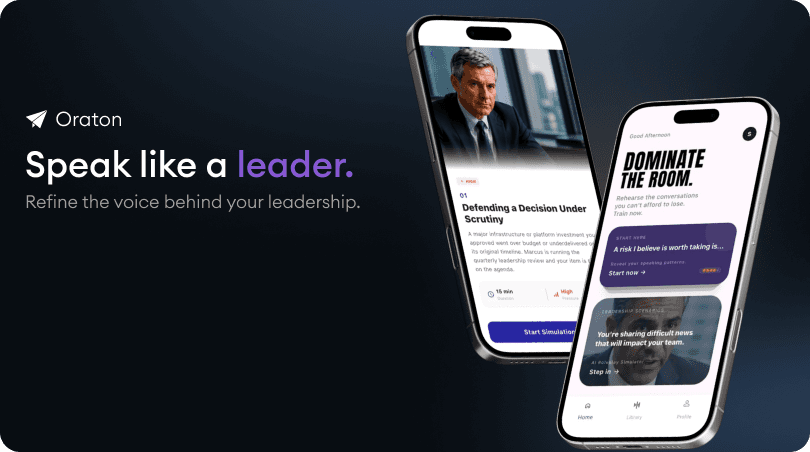
Oraton helps professionals prepare for high-stakes conversations through AI-powered roleplays, speech practice and structured communication feedback.
Because your experience deserves to be heard with the clarity it deserves.
You have spent years building your expertise. Make sure the way you communicate reflects it.
Explore leadership communication practice with Oraton.