•
10 Mins Read.





Organizations routinely promote their best performers into leadership and then leave them to work out the rest. The result is predictable: capable specialists who have never been taught to coach, delegate, or make decisions on behalf of others. Leaders developing leaders is the deliberate practice of preparing other people to lead through example, responsibility, feedback, coaching, and sponsorship. It is a duty of senior leaders, not a task to hand off to HR.
This guide explains what the idea means, why it matters, and how to put it into practice. You will get seven strategies, a 90-day leadership development plan, a comparison of training, development, mentoring, and coaching, and a way to measure results. If you are working out how to develop future leaders in your organization, or how companies develop great leaders, the aim is steps you can begin this quarter.
What Does Leaders Developing Leaders Mean?
Leaders developing leaders means experienced leaders take deliberate responsibility for preparing others to lead. They do this by modelling the behavior they expect, giving people real responsibility, offering timely feedback, coaching decisions, and advocating for them when opportunities arise. It is a continuing process, not a workshop or a promotion.
It helps to separate two goals. Developing an employee's current performance means helping them do today's job better. Preparing an employee for broader leadership means building the judgment, influence, and decision-making needed for a bigger role that they may not yet hold. A strong analyst can excel at the first and still be unready for the second.
Leadership development is also not the property of one level of the organization. Senior leaders shape the culture and decide who gets opportunities. Middle managers see the daily work and are best placed to coach and delegate. Emerging leaders develop one another through peer learning and, increasingly, by developing the people who report to them. When this works, developing leaders at every level becomes a habit rather than an initiative.
Why Is Developing Future Leaders Important?
The case for developing leaders rests on four outcomes. Each is tied to a research finding below, along with what the finding actually measures and the decision it should inform.
Succession continuity. DDI's Global Leadership Forecast 2025 surveyed 2,185 HR professionals and 10,796 leaders across more than 50 countries [1]. DDI reports that 77% of CHROs lack confidence in their bench strength for critical roles [2]. This measures HR leaders' confidence, not actual succession outcomes, but it points to a widespread gap. The decision it should inform: name more than one credible successor for each critical role, and start developing them now.
Internal mobility. The same DDI study found that high-potential employees are far more likely to leave when they are not developed. DDI's summary puts the figure at 3.7 times as likely [3]. This is DDI's own survey-based finding, so treat it as a strong signal rather than a proven causal effect. The decision it should inform: give high-potential people visible development plans and real assignments before a vacancy appears.
Manager effectiveness. Gallup estimates that managers account for at least 70% of the variance in team engagement scores across business units [4]. That statistic describes differences between teams, not how much any one manager controls an individual's engagement. The decision it should inform: invest in coaching, delegation, and decision-making skills for managers before promoting them further.
Organizational knowledge. The Center for Creative Leadership's foundational research, by Morgan McCall, Michael Lombardo, and Robert Eichinger, was based on interviews with roughly 200 successful executives. They most often credited challenging assignments and the people around them for their development, more than formal courses [5]. This is qualitative, retrospective evidence rather than a statistic, but it shows why judgment and relationships must be passed on through working together. The decision it should inform: pair emerging leaders with experienced ones on real work, not just in classrooms.
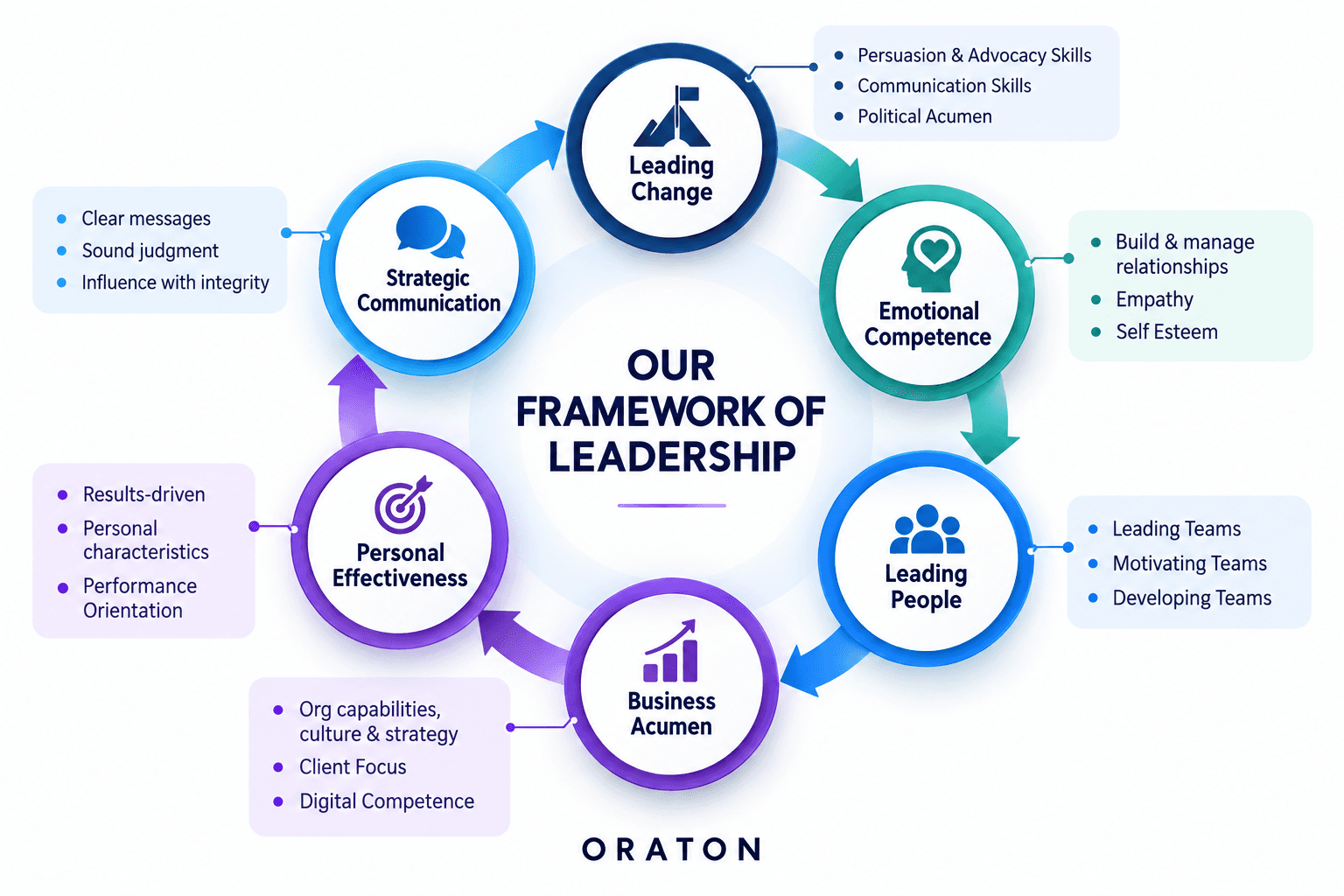
7 Strategies for Leaders Developing Leaders
Each strategy below covers what it is, why it works, how to apply it, and what to measure. Together they form a system: the first four shape day-to-day practice, and the last three make it consistent across the organization.
Strategy 1: Model the Leadership Behaviors You Expect From Others
Why it works. People watch how leaders behave under pressure, respond to mistakes, handle disagreement, and make decisions. Albert Bandura's social learning theory holds that people learn a great deal by observing and imitating others [6]. Stated values lose credibility when executive behavior contradicts them.
How to apply it. Make accountability, listening, decision-making, and emotional regulation visible in real meetings. Explain your reasoning, not only your conclusion. Acknowledge poor decisions openly. For example, an executive might say in a leadership meeting: “I approved that vendor change without testing it with the operations team. That was my error. Here is what I am doing to fix it and how we will decide differently next time.” That single moment teaches accountability more effectively than a values statement.
Try this exercise. Identify three behaviors your team sees you repeat every week. For each, ask: would I be comfortable if my direct reports copied this exactly? Then ask two of them what they observe.
What to measure. Feedback from direct reports, observed behavior change, and the consistency between stated values and actions.
Strategy 2: Give High-Potential Employees Real Leadership Responsibility
Why it works. Leadership requires judgment in situations that classroom training cannot fully reproduce. CCL's research is often summarized as the 70-20-10 framework: most development comes from experience, some from other people, and a smaller share from formal learning [5]. Treat it as a useful description of how executives said they learned, not as a universal formula. CCL itself notes that coursework has an amplifier effect on the other 90% [7].
How to apply it. A stretch assignment is not simply more work. It is a role with real stakes that pushes a person beyond their current capability, with support. Good examples include a cross-functional project, budget responsibility, leading a difficult meeting, or managing a stakeholder disagreement. Match the assignment to the person's current strengths and development needs: far enough to grow, not so far that they fail without a safety net. Use a simple cycle:
• Before: define the objective, success criteria, and what support is available.
• During: set guardrails, observe without taking over, and check in at agreed points.
• After: hold a debrief on decisions, results, and lessons.
What to measure. Scope of responsibility handled, quality of decisions, learning demonstrated, and readiness for the next assignment.
Strategy 3: Expose Emerging Leaders to Unfamiliar Situations
Why it works. Familiar responsibilities can hide weaknesses in judgment, communication, and stakeholder management. Unfamiliar situations reveal both strengths and gaps, and they build learning agility and adaptability.
How to apply it. Put emerging leaders in situations such as presenting to the board, resolving a conflict between functions, communicating an unpopular decision, or answering a hard question from a skeptical executive. Keep the cost of failure reasonable and stay close enough to support. Psychological safety matters: people learn from difficult experiences only when they can be honest about what went wrong.
Use this scenario debrief. Ask three questions afterward: What happened? What did you assume? What would you change next time? Then let the person try again in a similar situation.
What to measure. Improvement between attempts, the quality of reflection, and the ability to apply learning in a different situation.
Strategy 4: Coach in the Moment, Not Just During Annual Reviews
Why it works. Feedback is easiest to connect to behavior when it follows a specific event and points to what to try next. An annual review arrives too late to change the conversation that already went badly.
How to apply it. Coaching is different from mentoring, performance evaluation, and simply giving advice. It focuses on improving a specific behavior in the moment. Follow a repeatable sequence: observe, describe, ask, agree, practise, follow up. Useful questions include: “What were you trying to achieve?” “Where did the conversation change?” “What would you say differently?” Feedback should name a specific behavior and its impact, rather than label someone's personality. “You interrupted the CFO twice, and the discussion moved to defending the budget” is coachable. “You're too aggressive” is not.
What to measure. The frequency and usefulness of feedback, follow-through on agreed actions, and changes in observed behavior.
Why Leadership Communication Must Be Practised, Not Just Taught
Knowing a communication framework is different from applying it in a difficult meeting. Most emerging leaders can describe how to deliver feedback or handle disagreement. Far fewer can do it when a board member pushes back or a colleague becomes defensive. That gap closes through practice.
Emerging leaders can rehearse board presentations, disagreements, feedback conversations, and difficult stakeholder discussions before they happen. Structured feedback and repeated attempts help them spot specific behavioral improvements, such as answering the question asked, or holding a pause instead of filling it. Managers can build rehearsal into development plans alongside live assignments and coaching.
Oraton's scenario-based practice is one example of this approach. It complements, and does not replace, mentoring, real-world experience, or executive coaching.
Leadership is learned in the moments that test your judgment. Practise the conversations before they happen with Oraton.


Strategy 5: Teach Leaders to Develop Others Through Delegation
Why it works. Leaders who keep every important decision prevent others from building judgment and ownership. Delegation is one of the most practical ways to develop leadership skills in employees, because it hands someone responsibility they must learn to carry.
How to apply it. Distinguish between delegating tasks and delegating authority. A task says “complete this report.” Delegated authority says “own the recommendation and present the trade-offs.” Define the outcome, decision rights, constraints, checkpoints, and the conditions under which the person should escalate. Then resist the most common mistake: taking the work back at the first sign of difficulty. Ask questions instead of supplying answers.
What to measure. Decisions made independently, appropriate escalations, and expanding scope of ownership.
Strategy 6: Build Mentoring, Sponsorship, and Peer Learning Into the System
Why it works. Emerging leaders need different kinds of support: feedback on performance, access to experienced judgment, and someone who will put their name forward for meaningful assignments. No single relationship provides all of these.
How to apply it. Treat the four forms of support separately:
• Coaching improves specific behaviors and performance.
• Mentoring shares experience and perspective, usually over a longer horizon.
• Sponsorship means a senior leader actively advocates for someone's advancement and access to opportunities.
• Peer learning lets leaders at a similar level exchange problems, feedback, and approaches.
A simple mentoring meeting can follow this structure: a challenge the mentee is facing, what they have tried, the mentor's relevant experience, and one action before the next meeting. For sponsorship, a senior leader might recommend an emerging leader to present at the executive committee. Watch for fairness: avoid limiting opportunities to people who already have executive visibility.
What to measure. Quality of development relationships, access to stretch assignments, and movement into broader responsibilities.
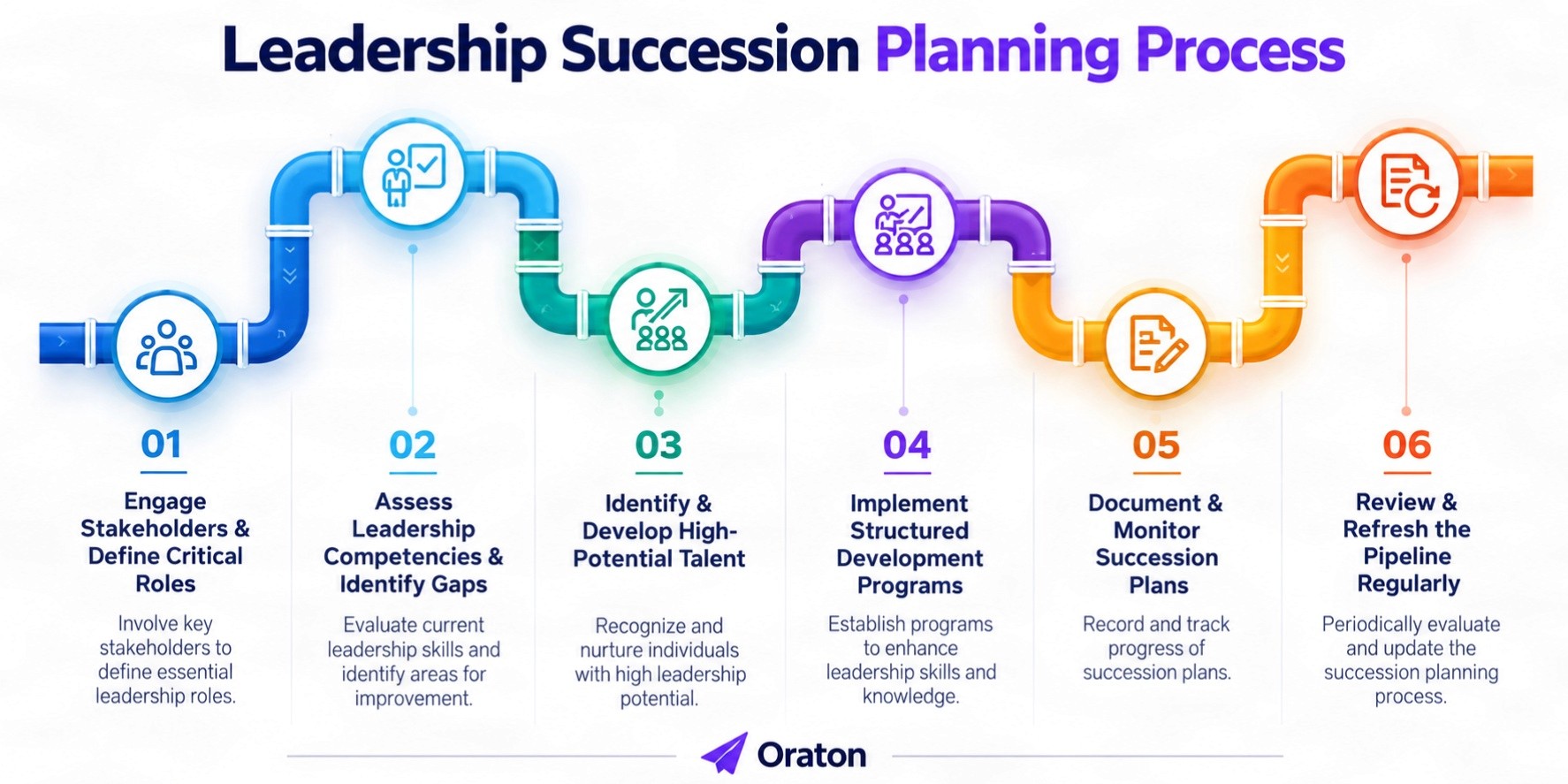
Strategy 7: Assess Leadership Potential and Prepare a Succession Pipeline
Why it works. An organization needs a repeatable way to identify future leadership needs and prepare more than one candidate for critical roles. CIPD describes succession planning as identifying and growing talent to fill business-critical positions in the future, and notes that programs typically include practical, tailored work experience [8].
How to apply it. Distinguish past performance, future potential, and readiness for a specific role, because they are three different things. Use role-specific criteria, structured assessments, feedback, and evidence from stretch assignments. Hold regular talent reviews and sort successors into readiness categories such as ready now, ready in one to two years, and longer term. A succession plan must include development actions, not just names against vacancies.
What to measure. Internal successor coverage, readiness for critical roles, progress against development plans, and retention of key talent.
How to Build a Leadership Development Plan: A Step-by-Step Framework
If you want leadership development steps you can act on, start with a 90-day plan. It will not finish anyone's development, but it creates measurable progress and a clear next step.
Period | Action and output |
Days 1–30 | Assess leadership capability, collect feedback, define the target role, and identify two development priorities. |
Days 31–60 | Assign a stretch project, establish coaching sessions, and practise a relevant high-stakes leadership scenario. |
Days 61–90 | Review performance, gather feedback, repeat the scenario, and document progress and the next development assignment. |
Two tips make this work. Limit each cycle to two priorities, because a plan with eight goals is a wish list. And repeat the same scenario at the end, so the improvement can be seen and not just reported.
Copy this leadership development plan template:
Field | Your entry |
Leadership goal |
|
Current capability |
|
Target behavior |
|
Development activity |
|
Coach or sponsor |
|
Success measure |
|
Review date |
|
Leadership Development vs. Leadership Training vs. Mentoring
These terms are often used interchangeably, but they do different jobs.
Approach | Primary purpose | Example |
Leadership training | Introduce knowledge and frameworks | Decision-making workshop |
Leadership development | Build capability over time | Stretch assignment with feedback |
Mentoring | Transfer experience and perspective | Senior leader advising an emerging leader |
Coaching | Improve specific behaviors and performance | Debriefing a difficult conversation |
These approaches complement one another. Training supplies the vocabulary, development supplies the experience, mentoring supplies perspective, and coaching sharpens behavior. None of them alone is a complete leadership development system.
How to Measure the Success of Leadership Development
Measuring activity is not the same as measuring results. Counting workshops attended tells you the program ran, not that leaders improved. Track four categories:
• Participation: coaching sessions held, assignments completed, and development plan reviews.
• Behavior: feedback quality, delegation, decision-making, and communication.
• Talent outcomes: internal promotions, successor readiness, and retention.
• Business outcomes: team performance, execution, and continuity during leadership transitions.
Be careful with causation. If team performance improves after a development program, the program may be one reason among many. Establish a baseline before you begin, track changes over time, and compare against groups that were not part of the program where you can.
Common Mistakes That Prevent Leaders From Developing Other Leaders
1. Promoting strong individual contributors without assessing leadership capability. Consequence: new managers struggle and their teams pay for it. Fix: assess the leadership behaviors the role requires and offer a trial through a stretch assignment first.
2. Delegating responsibility without decision-making authority. Consequence: people are accountable for outcomes they cannot influence. Fix: state decision rights and escalation conditions up front.
3. Treating the annual review as the whole development process. Consequence: feedback arrives too late to change behavior. Fix: coach after specific events and follow up.
4. Giving stretch assignments without support, feedback, or a debrief. Consequence: people experience the assignment as a test and learn little from it. Fix: use the before, during, after cycle every time.
5. Naming successors without giving them real development opportunities. Consequence: the names on the plan are not ready when the vacancy arrives. Fix: attach a specific development action and a review date to every named successor.
Frequently Asked Questions
What does leaders developing leaders mean?
It is the deliberate process through which leaders prepare others for leadership responsibility. They do this by modelling behaviors, providing real experience, coaching, and creating opportunities for growth. It is continuous and shared across levels, not a single program or a promotion.
How do leaders develop future leaders?
Effective leaders combine several practices: stretch assignments, mentoring, in-the-moment coaching, honest feedback, role modelling, and structured assessments of leadership readiness. No single practice is enough. The seven strategies above show how they fit together.
Why is it important for leaders to develop other leaders?
It protects succession continuity, builds internal talent, raises leadership capability, and reduces dependence on a few individual executives. It also lets organizations fill critical roles from within and keep the knowledge and relationships that leaders have built.
What is the difference between leadership development and succession planning?
Leadership development builds capability in people. Succession planning identifies what future roles will require and prepares potential successors for them. They work together: a succession plan without development actions is only a list of names.
What are the five practices of effective leadership development?
Five grouped practices are role modelling, experiential learning, coaching, delegation, and talent assessment. Each maps to the strategies above: modelling (Strategy 1), experience (Strategies 2 and 3), coaching (Strategy 4), delegation (Strategy 5), and assessment (Strategy 7).
How can managers develop leadership skills in their employees?
Assign real ownership of an outcome, give specific and timely feedback, coach their decision-making by asking questions instead of supplying answers, and increase responsibility progressively as they show readiness. Debrief each assignment so the learning is captured.
How long does leadership development take?
Development is continuous. A 90-day plan can establish measurable progress, but readiness for a particular leadership role depends on the role and on demonstrated capability, not on a fixed timeline.
Bottom line: leaders developing leaders is a system, not a slogan. Model the behavior, give real responsibility, coach in the moment, delegate authority, build relationships that support growth, and plan for succession, then measure what changes.
Leadership is learned in the moments that test your judgment. Practise the conversations before they happen with Oraton.
Practise a High-Stakes Conversation→
References
[1] DDI. (2025, January 22). Global Leadership Forecast 2025 study signals looming leadership exodus. https://www.ddi.com/about/media/global-leadership-forecast-2025
[2] DDI. (2025, November 21). Leadership Trends 2026. https://www.ddi.com/blog/leadership-trends-2026
[3] DDI. Global Leadership Forecast 2025 report summary (high-potential retention finding). https://www.ddi.com/research/global-leadership-forecast-2025
[4] Gallup. Managers Account for 70% of Variance in Employee Engagement, citing State of the American Manager: Analytics and Advice for Leaders (2015). https://news.gallup.com/businessjournal/182792/managers-account-variance-employee-engagement.aspx
[5] McCall, M. W., Lombardo, M. M., & Eichinger, R. W. Research at the Center for Creative Leadership; see CCL, The 70-20-10 Rule for Leadership Development. https://www.ccl.org/articles/leading-effectively-articles/70-20-10-rule/
[6] Bandura, A. (1977). Social Learning Theory. Prentice Hall.
[7] Center for Creative Leadership. The 70-20-10 Rule for Leadership Development. https://www.ccl.org/articles/leading-effectively-articles/70-20-10-rule/
[8] CIPD. Succession planning factsheet. https://www.cipd.org/en/knowledge/factsheets/succession-planning-factsheet/
Previous

Explore 10 leadership lessons from movies, revealing what films like Remember the Titans, Gladiator, Rocky Balboa and The Devil Wears Prada teach about communication, teamwork and leadership.
Next

Gallup's latest research shows that leaders often report better lives overall while experiencing significantly harder days. The difference highlights why leader engagement, not just employee engagement, has become a strategic leadership priority.