•
5 Mins Read.

Two executives walk into the same boardroom. Both have impressive qualifications, years of experience and a strong understanding of the business.
One presents brilliant ideas but struggles to get people on board. The other communicates with clarity, handles disagreement constructively, builds trust and brings different stakeholders together.
When the organisation needs someone to lead its next big transformation, who gets the call?
Increasingly, the answer is the person who knows how to work with people.
High-performance people skills are the interpersonal, emotional and communication capabilities that enable professionals to collaborate, influence decisions, manage relationships and lead effectively. They complement technical expertise and help individuals translate their knowledge into measurable organisational impact.
In today's workplace, these skills are no longer optional extras. They are essential leadership capabilities.
Here are seven people skills that can significantly influence professional performance and career progression.
What Are High-Performance People Skills?
High-performance people skills are a combination of interpersonal abilities, emotional intelligence, communication techniques and behavioural competencies that help individuals work effectively with others.
They enable professionals to:
Build productive workplace relationships.
Communicate ideas clearly and confidently.
Influence stakeholders without relying on authority.
Navigate difficult conversations and disagreements.
Adapt to different personalities and working environments.
Give and receive constructive feedback.
Build trust and improve team collaboration.
Unlike technical skills, which demonstrate what someone knows, people skills influence how effectively that knowledge is applied in a professional environment.

1. Emotional Intelligence: Understand People Before You Lead Them
Emotional intelligence is the ability to recognise, understand and manage your own emotions while responding effectively to the emotions of others.
Imagine a senior manager receiving an unexpected challenge from a board member. One response is to become defensive and justify every decision. Another is to remain composed, understand the concern and address it with evidence.
The difference is emotional intelligence.
It involves four important capabilities:
Self-awareness: Recognising your emotional triggers, strengths and behavioural patterns.
Self-regulation: Managing reactions under pressure rather than responding impulsively.
Empathy: Understanding another person's perspective without necessarily agreeing with it.
Social awareness: Reading interpersonal dynamics and recognising how your behaviour affects others.
For leaders, emotional intelligence is particularly important during performance reviews, organisational change, negotiations and high-pressure decisions.
The objective is not to become everyone's favourite person. It is to become someone people can work with, trust and respect.
2. Communication: The People Skill That Amplifies Every Other Skill
Communication is one of the most important high-performance skills for professionals because it determines how effectively ideas, decisions and expectations are understood.
You can have an excellent strategy, compelling data and the right solution. But if you cannot explain your thinking clearly, your contribution may never receive the attention it deserves.
Consider the situations that shape a senior professional's reputation:
Presenting a strategic recommendation to the board.
Challenging a senior stakeholder without damaging the relationship.
Delivering difficult feedback to an underperforming employee.
Defending a business decision under scrutiny.
Leading meetings where competing priorities need resolution.
Each requires more than the ability to speak fluently. It requires structured thinking, active listening, audience awareness and the ability to communicate with authority.
Three habits distinguish effective professional communicators.
Lead with the point. State your recommendation or central message before getting into supporting details. Senior stakeholders need clarity, not a suspense novel.
Listen to understand. Active listening involves paying attention, asking relevant questions and recognising the concerns behind someone's words.
Adapt your delivery. A boardroom presentation, a performance review and a conversation with a new employee require different communication approaches.
The real measure of communication is not how much you say. It is what the other person understands, remembers and acts upon.
For ambitious professionals, communication is also closely connected to leadership presence. The ability to articulate complex ideas, respond confidently to challenging questions and make a persuasive case can influence how others perceive professional competence.
3. Influence Without Authority: Earn Buy-In Beyond Your Job Title
A senior designation may give you authority. It does not automatically give you influence.
Modern organisations depend on cross-functional collaboration. A product director needs engineering and sales to align. A strategy leader needs multiple departments to support an initiative. A founder needs employees, investors and customers to believe in a vision.
These outcomes cannot be achieved through hierarchy alone.
Influence without authority is the ability to gain support, shape decisions and persuade stakeholders without relying on formal reporting relationships.
It requires three things: credibility, an understanding of stakeholder priorities and persuasive communication.
Instead of asking, "How do I get them to agree with me?", ask, "What would make this decision valuable to them?"
That small shift can transform the quality of professional relationships.
4. Conflict Resolution: Turn Disagreement Into Better Decisions
Disagreement is not necessarily a sign of a dysfunctional team. Sometimes it is evidence that people care enough to challenge an idea.
Consider a sales director pushing for an immediate product release to secure a major client, while the product director insists on another development cycle.
One sees a revenue opportunity. The other sees an operational risk.
Both may be right.
Effective conflict resolution involves identifying the underlying concern, separating facts from assumptions and finding common ground.
Leaders who manage conflict well:
Address issues before they escalate.
Focus on behaviour and outcomes rather than personalities.
Ask questions before making assumptions.
Recognise competing priorities.
Agree on practical next steps.
The objective is not to win every argument. It is to reach better decisions without destroying the relationships required to execute them.
5. Adaptability: Stay Effective When Circumstances Change
Markets change. Technology disrupts established processes. Teams evolve. Customer expectations shift.
Adaptability is the ability to adjust your thinking, behaviour and approach while remaining focused on the larger objective.
For professionals, this means questioning established assumptions, accepting new information and learning to work with different personalities and perspectives.
The most effective leaders are not necessarily those who have an answer for everything. They are those who can recognise when their existing answer no longer works.
In a rapidly changing business environment, the ability to learn, unlearn and respond intelligently is a significant professional advantage.
6. Feedback: Make Difficult Conversations Productive
Most professionals claim to value feedback. Fewer enjoy receiving it.
A poorly delivered piece of feedback can trigger defensiveness. A well-structured conversation can create clarity and improve performance.
Compare these two statements:
"You need to be more professional in meetings."
"In yesterday's client meeting, you interrupted the presentation twice before the recommendation was complete. Let the speaker finish before challenging the proposal."
The first judges a person. The second identifies an observable behaviour that can change.
Effective feedback should be specific, timely, constructive and focused on actions rather than personal characteristics.
Equally important is the ability to receive feedback without immediately defending yourself.
High performers understand that feedback is information they can use, not necessarily criticism they must resist.
7. Collaboration and Trust: Build Teams That Perform Together
A team is not high-performing simply because everyone is busy.
Real performance emerges when people understand shared priorities, trust one another and feel accountable for collective outcomes.
Trust is built through consistency. Leaders must follow through on commitments, acknowledge mistakes, recognise contributions and create an environment where people can raise concerns.
Collaboration also requires making space for different perspectives.
The best idea in a room does not always come from the most senior person. Sometimes it comes from the newest employee, the quietest specialist or someone approaching the problem from an entirely different angle.
A leader's responsibility is to ensure that good ideas are heard, evaluated and acted upon.
How Can Professionals Develop High-Performance People Skills?
People skills are not personality traits reserved for naturally charismatic individuals. They are learnable capabilities that improve through deliberate practice, feedback and experience.
Professionals can strengthen these skills by:
Practising active listening: Focus on understanding before preparing your response.
Improving communication structure: Organise your ideas before important meetings and presentations.
Seeking constructive feedback: Ask colleagues how your communication and behaviour affect collaboration.
Practising difficult conversations: Prepare for negotiations, disagreements and performance discussions.
Reflecting on interactions: Identify what worked, what did not and what you would change.
Building adaptability: Seek perspectives beyond your immediate team and professional discipline.
Practising consistently: Treat interpersonal effectiveness as a professional capability that requires ongoing development.
The goal is not to become a different person. It is to become more effective in the situations that matter.
The New Definition of Professional Excellence
For decades, professional development placed considerable emphasis on technical expertise, qualifications and measurable individual achievements.
These remain important. But they tell only part of the story.
The next generation of high-performing professionals will be distinguished by how effectively they combine competence with interpersonal effectiveness.
They will know how to make decisions and bring people along. How to challenge ideas without alienating colleagues. How to communicate complex thinking simply. How to lead through uncertainty and build trust across organisational boundaries.
And they will understand something fundamental: being good at your job and being able to demonstrate that effectively are two different capabilities.
Your career is shaped not only by the quality of work you produce, but also by the quality of interactions you create along the way.
Technical expertise may establish your credibility. High-performance people skills determine how effectively you translate that credibility into influence, leadership and lasting impact.
Because business is not just about getting work done.
It is about getting the right work done, with the right people, through the right conversations.
Frequently Asked Questions About High-Performance People Skills
What are the important people skills for professionals?
The seven essential people skills are emotional intelligence, communication, influence without authority, conflict resolution, adaptability, feedback management, and collaboration and trust. Together, these capabilities help professionals build relationships, navigate workplace challenges and improve leadership effectiveness.
Why are communication skills important for high performance?
Communication skills help professionals articulate ideas, influence decisions, manage stakeholder expectations and build alignment. Strong communication ensures that technical expertise and business knowledge translate into meaningful action and organisational impact.
Can people skills be learned and developed?
Yes. People skills can be developed through deliberate practice, professional feedback, workplace experience and structured learning. Skills such as active listening, emotional regulation, persuasive communication and conflict resolution improve with consistent application.
What is the difference between technical skills and people skills?
Technical skills demonstrate a person's knowledge and ability to perform specific tasks. People skills determine how effectively that person communicates, collaborates, influences others and manages professional relationships. Both are essential for sustained career success.
Which people skills are most important for senior leaders?
Senior leaders particularly benefit from strategic communication, emotional intelligence, influence without authority, conflict resolution, adaptability and stakeholder management. These capabilities help leaders align teams, communicate strategic priorities and navigate complex organisational decisions.
How can professionals improve their leadership communication?
Professionals can improve leadership communication by structuring their messages, leading with clear recommendations, practising active listening, adapting their delivery to different audiences and preparing for high-stakes conversations. Consistent practice and actionable feedback help strengthen communication effectiveness over time.
About Oraton
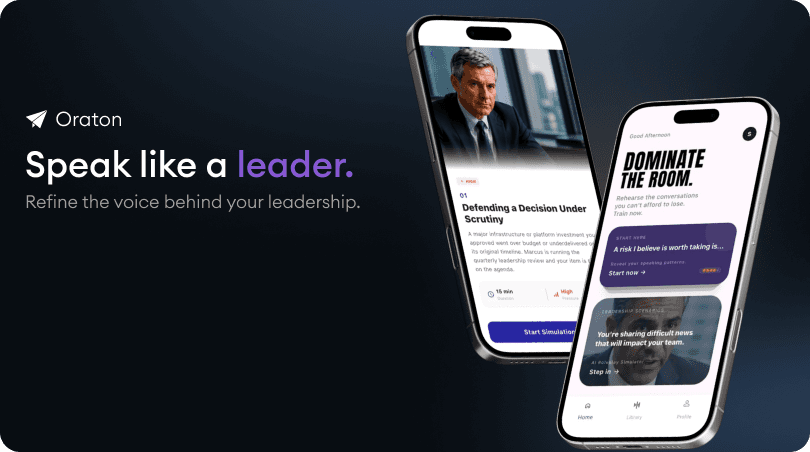
Oraton is a leadership communication practice platform designed for ambitious professionals, senior executives, founders and business leaders.
Through structured speaking exercises, AI-powered feedback and realistic high-stakes conversation simulations, Oraton helps professionals practise communicating with greater clarity, structure and leadership presence.
Because professional expertise deserves equally effective communication.