•
6 Mins Read





One of the most common mistakes in management is assuming that good leadership has a single recognizable style.
Some managers lead through detailed instructions. Others give people considerable autonomy. Some spend more time coaching. Others focus on removing obstacles and letting experienced employees operate independently.
Which approach is correct?
The Hersey-Blanchard Situational Leadership Model offers a deceptively simple answer:
It depends on the person, the task, and the person's level of development.
Developed by Paul Hersey and Kenneth Blanchard, the model argues that leaders should adapt their behavior rather than apply one management style to every employee and every situation. It evaluates development through two broad dimensions: a person's ability to perform a task and their willingness or confidence to take responsibility for it.
That makes the model particularly useful for managers dealing with a reality that traditional leadership advice often ignores: the same employee may need very different leadership at different points in their development.
A person may need close direction when learning a new responsibility, coaching as they develop competence, support when they become technically capable but lack confidence, and delegation once they can operate independently.
The challenge is not memorizing four labels.
The challenge is learning to diagnose what the situation actually requires.
What Is the Hersey-Blanchard Situational Leadership Model?
The Hersey-Blanchard Model, also known as the Situational Leadership Model, is a leadership framework that matches a leader's behavior to an employee's development level for a particular task.
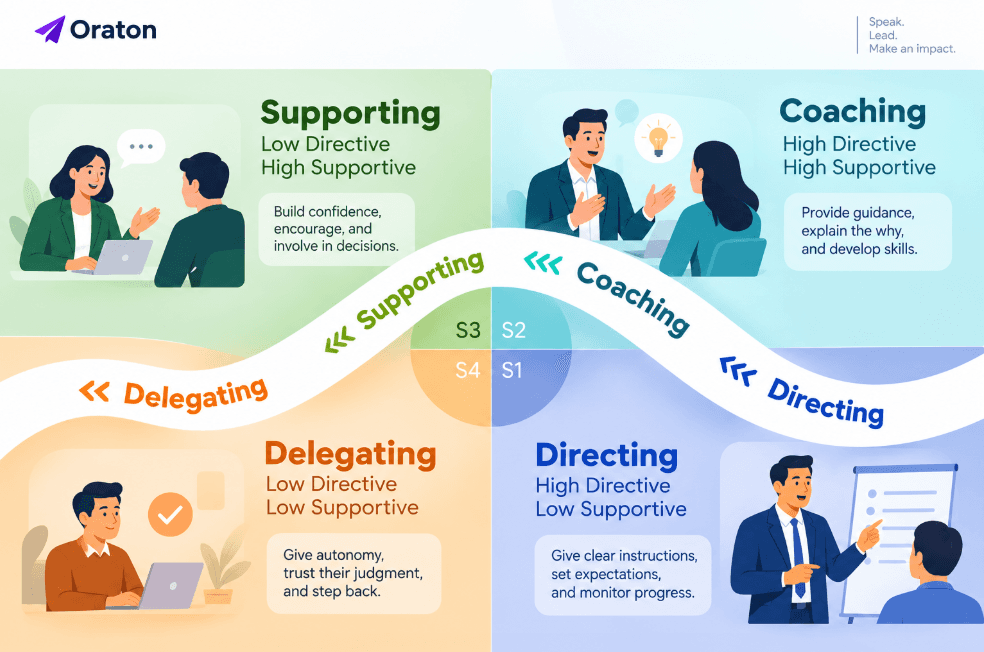
The framework identifies four development levels:
Development level | Description |
|---|---|
D1 | Unable and unwilling |
D2 | Unable but willing |
D3 | Able but unwilling |
D4 | Able and willing |
The important word is task.
These levels should not be treated as permanent descriptions of a person.
An experienced finance executive could be highly capable of preparing a financial forecast but relatively inexperienced at implementing a new enterprise technology system.
The same person could therefore require different leadership approaches depending on the responsibility.
That is the central insight behind situational leadership.
The 4 Hersey-Blanchard Leadership Styles
The model connects those four development levels with four leadership styles:
S1: Directing
S2: Coaching
S3: Supporting
S4: Delegating
CFI's explanation similarly describes the four approaches as increasing or decreasing levels of direction and support depending on employee development.
The model therefore asks leaders to adjust two things:
How much direction do I provide?
How much support do I provide?
That creates four different leadership responses.
1. S1: Directing
The Directing style is designed for situations in which an employee lacks the ability and willingness or confidence required to perform the task independently.
The leader provides:
Clear instructions
Defined responsibilities
Specific expectations
Close supervision
Clear deadlines
Frequent clarification
This is where the model differs from simplistic interpretations of micromanagement.
Micromanagement means controlling work without regard to what the employee actually needs.
Directing is supposed to be diagnostic.
If someone genuinely lacks the knowledge or experience required to perform a task, giving them autonomy before they are ready does not develop them. It simply transfers risk to them.
Example
A newly promoted manager is conducting their first performance review.
They may need:
A review framework
Sample questions
Clear expectations
A defined process
Guidance on difficult conversations
The objective is not to control them indefinitely.
It is to provide enough structure for them to become capable.
Communication priority: clarity.
2. S2: Coaching
The Coaching style becomes appropriate when someone is motivated to succeed but still lacks sufficient experience or capability.
The leader continues to provide direction, but adds explanation and support.
This changes the communication equation.
The leader is no longer saying only:
"Do this."
They are increasingly explaining:
"Here is why we are doing this."
And asking:
"What do you think?"
Coaching is therefore a bridge between instruction and independence.
Example
A newly appointed product manager understands the mechanics of prioritization but has limited experience making difficult trade-offs.
The leader might:
Review decisions
Explain trade-offs
Challenge assumptions
Provide feedback
Discuss alternatives
Gradually reduce intervention
The objective is to develop judgment, not merely task completion.
Communication priority: explanation and feedback.
3. S3: Supporting
The Supporting style is different.
At this stage, the employee may already possess the technical capability required to perform the task.
The problem may instead be confidence, motivation, commitment, or willingness to take ownership.
The leader therefore reduces task direction and increases support.
The conversation changes from:
"Here is exactly what you need to do."
to:
"What do you think we should do?"
That shift matters.
A leader who continues giving detailed instructions to someone who already knows how to perform the work may unintentionally communicate distrust.
Example
A senior analyst has the technical ability to build a sophisticated model but hesitates to present recommendations to the executive team.
The leader does not need to teach the analyst how to build the model.
They may need to:
Ask questions
Strengthen confidence
Challenge reasoning
Provide perspective
Encourage ownership
Communication priority: dialogue and confidence.
4. S4: Delegating
The Delegating style is appropriate when an employee has the capability, experience, confidence, and willingness to take responsibility for the task.
The leader provides relatively little direction and support.
But delegation does not mean disappearing.
The leader still establishes:
The desired outcome
The boundaries
The accountability
The resources
The point at which progress should be reviewed
What changes is who controls execution.
Example
An experienced department head has successfully delivered similar strategic projects multiple times.
Continuing to prescribe every step does not necessarily improve the outcome.
It may simply create unnecessary management overhead.
At this point, the leader can define the outcome and allow the person to determine how to achieve it.
Communication priority: outcomes, boundaries, and ownership.
The Core Idea: Leadership Should Adapt to Development
The most useful insight in the Hersey-Blanchard Model is not the four-box diagram.
It is the rejection of one-size-fits-all leadership.
A manager who uses the same amount of direction with everyone creates two problems.
Less experienced employees may receive too little structure.
Experienced employees may receive too much.
The model therefore turns leadership into a calibration problem.
Instead of asking:
"What is my leadership style?"
Ask:
"What does this person need from me to succeed at this task right now?"
That is a significant shift.
Leadership becomes less about expressing a preferred management style and more about diagnosing another person's needs.
Why the Same Employee May Need Different Leadership Styles
This is arguably the most important practical implication of the model.
Development is task-specific.
Consider an executive who has spent ten years leading sales teams but has just been asked to oversee a cybersecurity transformation.
On sales strategy, that executive may operate at a high development level.
On cybersecurity implementation, they may depend heavily on technical specialists.
A leader who treats experience as a universal measure of capability can therefore make two opposite mistakes:
Over-management: assuming an experienced person needs detailed instructions.
Under-management: assuming experience in one domain automatically translates into competence in another.
The more useful question is:
Capable of what?
That question forces leaders to diagnose the actual work rather than rely on assumptions about the person.
How to Apply the Hersey-Blanchard Model at Work
The framework becomes much more useful when turned into a repeatable management process.
Step 1: Diagnose the task
Don't evaluate the employee in general.
Evaluate their readiness for the specific responsibility.
Ask:
Have they performed this task before?
Do they have the technical skills?
Have they encountered similar situations?
How much judgment does the task require?
What would failure cost?
Step 2: Diagnose willingness and confidence
Ability is only part of the equation.
Someone may know exactly how to perform a task but hesitate to act.
Another person may be highly motivated but inexperienced.
Those situations require different leadership conversations.
Step 3: Match direction to capability
If capability is low, provide more structure.
As capability increases, reduce unnecessary instruction.
The goal is not maximum autonomy.
The goal is the appropriate amount of autonomy for the current level of capability.
Step 4: Match support to confidence
Some employees need encouragement and discussion even when they already possess the technical skills.
In that situation, the leader's communication should shift from:
"Here is what you should do."
toward:
"What do you think we should do, and why?"
Step 5: Reassess
Development changes.
A person who needed coaching three months ago may now be ready for delegation.
An experienced employee given a completely unfamiliar responsibility may temporarily need more direction.
Situational leadership therefore works best as a continuous cycle of diagnosis and adaptation, rather than a one-time classification.
Hersey-Blanchard Model Example: One Employee, Four Leadership Styles


Imagine a marketing director introducing an employee to a new analytics platform.
D1: Unable and unwilling
The employee has never used the platform and is unsure where to begin.
The leader provides clear instructions and closely defines the first assignment.
Leadership response: Directing.
D2: Unable but willing
The employee understands the basic workflow and is enthusiastic but continues making mistakes.
The leader explains decisions, reviews the work, and provides regular feedback.
Leadership response: Coaching.
D3: Able but unwilling
The employee is technically competent but lacks confidence presenting insights to senior executives.
The leader asks questions, provides support, and gives the employee increasing ownership.
Leadership response: Supporting.
D4: Able and willing
The employee can independently analyze data, explain implications, and make recommendations.
The leader establishes the outcome and allows the employee to determine execution.
Leadership response: Delegating.
The work did not require four different employees.
It required four different leadership responses over time.
The Communication Lesson Hidden Inside the Hersey-Blanchard Model
The Hersey-Blanchard Model is normally presented as a management framework.
It is equally useful as a leadership communication framework.
Each stage changes what the leader needs to say.
Development | Leadership style | Communication emphasis |
|---|---|---|
D1 | Directing | What to do, how to do it, when it is due |
D2 | Coaching | Why it matters, explanation, feedback |
D3 | Supporting | Questions, judgment, confidence, ownership |
D4 | Delegating | Outcomes, boundaries, accountability |
This is where situational leadership connects directly to executive communication.
Leadership is not simply choosing the right words.
It is choosing the right level of intervention.
Too much direction can communicate distrust.
Too little direction can communicate neglect.
Too much support can create dependence.
Too little support can leave capable people isolated.
The communication challenge is calibration.
Where the Hersey-Blanchard Model Can Break Down
The model is useful, but it is not a complete theory of leadership.
CFI identifies two practical challenges with applying it: the individual-focused framework can be difficult to apply to teams containing people with different levels of ability and experience, and leaders may struggle to adapt their style when they have developed entrenched management habits.
There is also a diagnostic challenge.
An employee who appears unwilling may actually be unclear about expectations.
An employee who appears inexperienced may actually lack confidence rather than technical ability.
A team that appears capable of operating independently may still require substantial coordination because the work itself is highly interdependent.
The framework is therefore most useful as a diagnostic lens, not a mechanical formula.
The Biggest Leadership Mistake: Managing People Instead of Situations
The Hersey-Blanchard Model raises an interesting question about what "consistency" actually means.
Managers are often told to be consistent.
But consistency does not necessarily mean treating everyone identically.
A more sophisticated form of consistency is applying the same principle:
Give people the level of direction, support, and autonomy the situation requires for them to succeed and develop.
That may mean detailed direction for one employee, coaching for another, support for a third, and autonomy for a fourth.
From the outside, the manager may appear inconsistent, but from the inside, the logic is coherent.
What the Hersey-Blanchard Model Teaches About Executive Leadership
The model's enduring value is its reminder that leadership is relational.
A leader does not lead in the abstract.
A leader leads a person, toward an outcome, in a particular situation.
That requires at least three forms of judgment.
1. Diagnostic judgment
What does this person actually need?
2. Communication judgment
How much direction and support should I provide?
3. Adaptation judgment
When should I change my approach?
The strongest managers are therefore not necessarily those with the most forceful leadership style.
They are often the ones who can change the amount of structure, support, and autonomy without losing clarity about the outcome.
Hersey-Blanchard Situational Leadership Model: The Practical Takeaway
The Hersey-Blanchard Situational Leadership Model offers a simple but demanding proposition:
Leadership should change as capability and willingness change.
Direct when someone needs structure.
Coach when someone needs structure and development.
Support when capability exists but confidence or commitment needs strengthening.
Delegate when competence and ownership are established.
The difficult part is knowing which situation you are actually in, which requires leaders to listen carefully, diagnose rather than assume, and continuously reassess the relationship between capability, confidence, motivation, and task complexity.
In that sense, the Hersey-Blanchard Model is not really a lesson about four leadership styles.
It is a lesson about adaptive leadership judgment.
Frequently Asked Questions
What is the Hersey-Blanchard Situational Leadership Model?
It is a leadership framework developed by Paul Hersey and Kenneth Blanchard that proposes adapting leadership behavior to an employee's development level for a specific task.
What are the four Hersey-Blanchard leadership styles?
The four styles are Directing (S1), Coaching (S2), Supporting (S3), and Delegating (S4).
What are the four development levels in the Hersey-Blanchard Model?
The framework describes D1 as unable and unwilling, D2 as unable but willing, D3 as able but unwilling, and D4 as able and willing.
What is the main idea of situational leadership?
The central idea is that leaders should adapt their amount of direction and support to the employee's development and the demands of the task rather than use one fixed leadership style.
What are the limitations of the Hersey-Blanchard Model?
Applying an individual-focused model to teams with mixed development levels can be difficult, and leaders may struggle to adapt away from established management habits. CFI identifies both challenges in its overview.
Previous

The most watched presidential debate in modern history revealed an uncomfortable truth about influence. 8 years later, its biggest lesson may have less to do with politics and more to do with how leaders create clarity.
Next

Learn when hedging language builds credibility and when it weakens your message. Discover how executives, researchers, and business leaders use certainty and caution to communicate more effectively.