•
8 min read




Key Takeaways:
70% of organizational transformations fail, and one of the most common reasons isn't strategy or execution. It's the absence of a compelling change narrative.
Organizations where leaders communicate openly and consistently are 8x more likely to report successful transformations.
Nearly 50% of executives say they should have spent more time communicating the change story, not just the change plan.
People remember narratives far better than facts. Communication studies suggests stories can be remembered up to 22 times more effectively than standalone information.
Trust increasingly follows interpretation, not information. In Edelman's global research, 76% of respondents expected CEOs to lead change.
Narrative vacuums never stay empty. When leadership fails to define reality, employees, investors, customers, and voters create their own explanations, often increasing confusion and resistance.
The leadership advantage today isn't access to more data. It's the ability to turn complexity into a coherent story.
The Real Contest Isn't Policy. It's Interpretation.
Most people think elections are won through better policies..advertising, or candidates. Those things matter, yes, but they often distract us from a more fundamental reality.
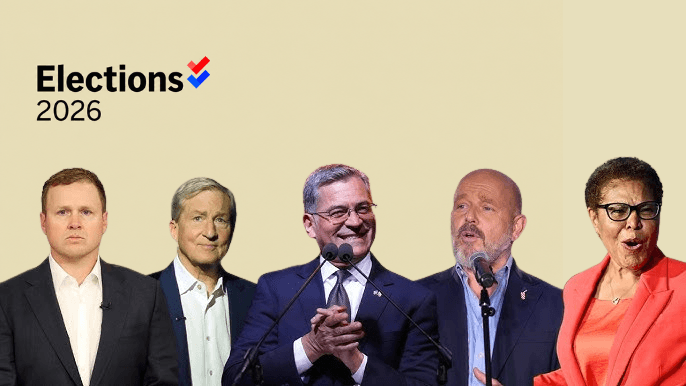
Elections are ultimately contests between competing narratives. And the candidate who succeeds is rarely the person with the longest policy platform, largest collection of facts or the biggest/most grandest plans. More often than not, it’s the person who offers voters the most coherent explanation of the world they currently inhabit and the future they should want. Witnessing California's gubernatorial race unfold has been a hard lesson for leadership that operates according to much the same principle. Whether the audience is voters, employees, investors, or a board of directors, people are constantly searching for a story that helps them make sense of uncertainty.
Facts matter. Data matters. Strategy matters. But before people evaluate any of those things, they are trying to answer a simpler question: what is actually going on here? “California race” has been particularly revealing because uncertainty has defined much of the contest. Crowded fields, overlapping policy positions, competing political identities, and a top-two primary system have created an environment where visibility alone is not enough.
As many candidates have had the resources to reach voters. Far fewer have succeeded in creating a narrative that voters can easily hold onto. That distinction is important because modern leaders often confuse communication with information distribution. They assume that if stakeholders receive enough updates, enough presentations, enough dashboards, and enough explanations, alignment will naturally follow. Yet human beings rarely process complexity that way.
Faced with an overwhelming amount of information, we look for patterns. We search for explanations. We build stories that help us understand cause and effect. The moment leaders fail to provide those stories, people create their own. This is one of the reasons so many organizational transformations struggle. A CEO announces a restructuring.
Employees receive dozens of slides explaining reporting lines, timelines, and operating models. Months later, confusion still persists. The problem is not a lack of information. It’s that..nobody really clearly articulated the narrative underneath the change.
What challenge is the company trying to solve? Why is this moment different from previous attempts? What future are the employees being asked to help create? The same dynamic plays out in boardrooms, as well. Directors rarely struggle because they lack access to data. Most boards receive more information than they can realistically absorb. What they are often looking for is an interpretation of that information. They want to understand what the numbers mean, what risks matter most, and how management sees the future unfolding. In other words, they are looking for a narrative.
The Leadership Advantage in an Age of Information Overload
California’s election highlights another uncomfortable truth about leadership communication. In periods of uncertainty, narrative vacuums do not remain empty for long. If leaders fail to define reality, someone else will. Employees fill information gaps with speculation. Investors fill them with assumptions. Customers fill them with perceptions. Voters fill them with competing political narratives. This is why communication is fundamentally different from broadcasting messages. The most effective leaders are not simply transmitting information.
They are actively shaping how people interpret events. They understand that every major decision, every strategic shift, every crisis, and every moment of change will inevitably generate competing explanations. Their job is not merely to explain what happened. Their job is to help people understand what it means.
The most important lesson from California's race? It’s that leadership influence is rarely built through volume…modern campaigns spend millions of dollars attempting to capture attention. Organizations? They do the same with internal communications, town halls, strategy presentations, and endless streams of updates. Yet attention and understanding are not the same thing.
The leaders who create lasting influence are not necessarily those who communicate most frequently. They're the ones who provide a clear lens through which people can interpret complexity.
Goal is to give people a story that feels coherent, credible, and connected to reality. In uncertain environments, that ability becomes a competitive advantage. Elections are won that way. Companies are led that way. And increasingly, in a world overflowing with information, trust belongs to the people who can make sense of the noise.


Previous

Enron's $74 billion collapse is usually remembered as a story about fraud. But more than two decades later, its most important lesson may be about something far more dangerous: the psychology of success.
Next

Board packs don't win the room. See the best AI tools for board meeting prep in 2026, from rehearsal to board books to minutes.