•
12 Mins Read





A pitch deck exists to get you a second conversation, not to close a deal on the spot. Its purpose is to compress your business idea, market opportunity, and traction into a format an investor can evaluate quickly, decide it's worth their time, and use as a reference point through the rest of the fundraising process.
Table of contents
The real purpose behind a pitch deck
The three jobs a pitch deck does
As a visual aid
As a narrative device
As proof of financial thinking
How the purpose shifts by funding stage
How the purpose shifts by audience
What founders get wrong about a deck's purpose
FAQs
Conclusion
The real purpose behind a pitch deck
For most founders, a pitch deck is the only realistic way to get in front of venture capital. There's no other document that reliably opens that door: not a resume, not a business plan, not a cold email on its own. A deck that works doesn't need to convince someone to invest on the spot. It needs to convince them the conversation is worth having.
That distinction matters because it changes what "good" looks like. A pitch deck isn't judged on how complete it is. It's judged on whether it makes an investor curious enough to ask for a meeting, and confident enough, once they're in that meeting, that they aren't wasting their time.
Three things tend to happen inside a working deck. It lays out the business idea and what makes it different from the dozen adjacent ideas an investor has already seen this month. It sizes the market honestly enough that the opportunity is legible, not just asserted. And if the company has grown past the earliest stage, it shows the financial signals that back up the story instead of just the story itself.
The three jobs a pitch deck does
Strip away the slide count and the design choices, and a pitch deck is really doing three separate jobs at once: it's a visual aid, a narrative device, and (once there's data to show) a record of financial credibility. Founders who understand which job a given slide is doing tend to build much stronger decks than founders who just work through a template.
As a visual aid
A slide deck is a visual medium, and it should be treated like one. Full paragraphs on a slide do the opposite of what they're meant to do: they pull attention down into reading instead of up into listening, and they make the deck harder to skim later when an investor forwards it to a partner who wasn't in the room.
The stronger approach is to say less on the slide and more out loud. A single sharp number, a short phrase, or a relevant image usually does more work than three sentences of explanation. The slide should support what you're saying, not repeat it.
As a narrative device
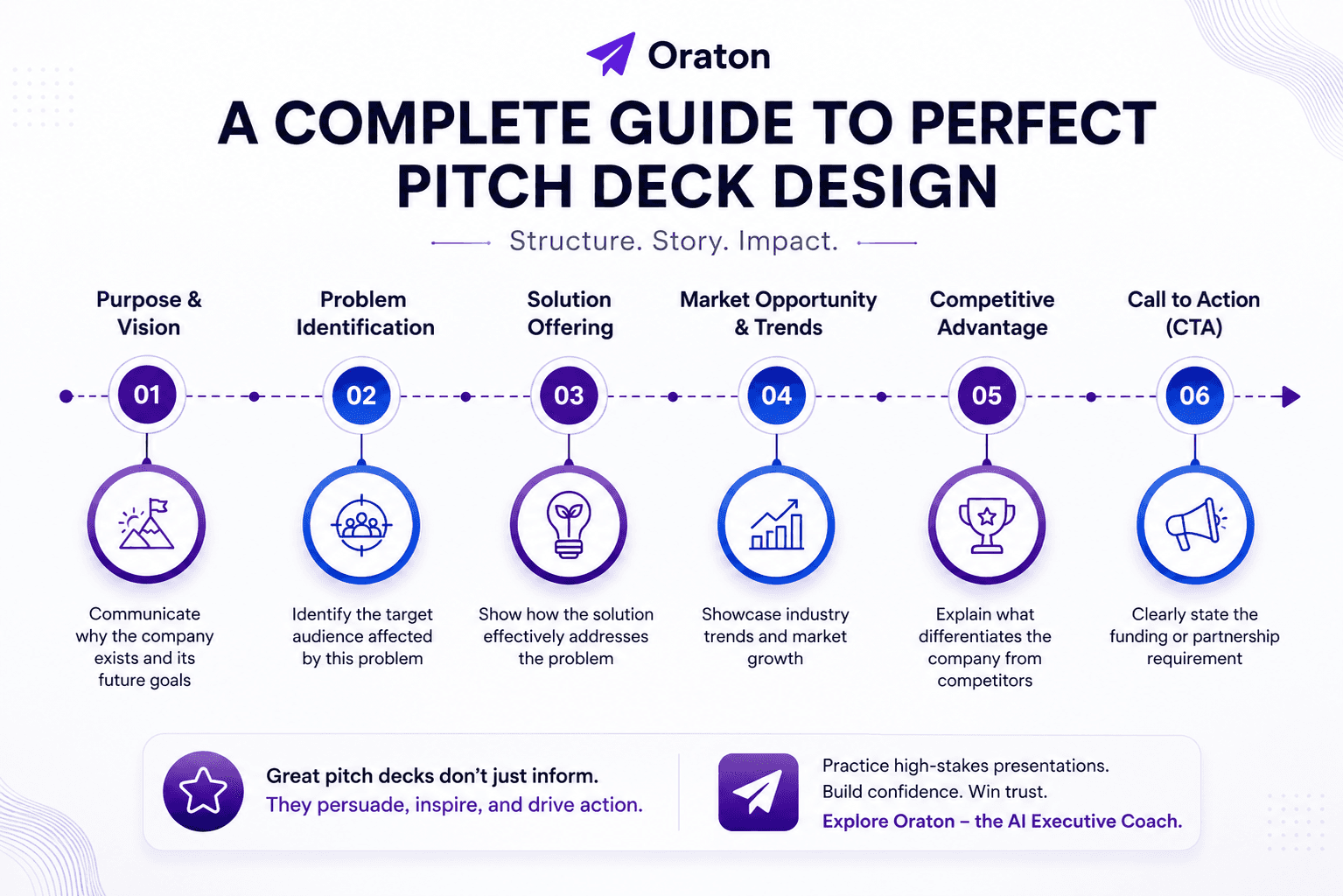
The clearest way to structure a pitch deck is as a story, not a report. Your team plays the role of the protagonist. The market problem is the obstacle standing in the way. Your product or business model is what gives the team the ability to overcome it.
This maps onto the three-act structure that shows up across most narrative writing: the setup, the turn, and the resolution. Decks that follow this shape, establishing what's broken today, introducing the solution as the pivot point, then building toward proof that it's working, tend to land better than decks that just march through a checklist of sections in no particular emotional order. The goal isn't to sound like fiction. It's to give an investor a reason to care about the outcome before you ask them to fund it.
As proof of financial thinking
Once a company has real metrics, the deck's purpose expands to include reassurance: proof that growth isn't hypothetical. A grounded competitive analysis, a clear revenue model, and honest sales figures do more to support a funding ask than confident language ever will.
This is also where a lot of first-time founders lose credibility, not because their numbers are bad, but because their financial model doesn't hold together under a few basic questions. If you haven't built a financial model before, it's worth learning the basics of driver-based modeling (revenue built up from real assumptions like conversion rate and price, rather than a top-down guess) before you put projections in front of an investor.
How purpose shifts by stage
A pitch deck's job changes depending on how far along the company is, and pretending otherwise is one of the fastest ways to lose credibility with an experienced investor. What convinces a seed investor will not convince a Series A investor, and using a seed-stage deck at a Series A conversation is a signal in itself: it tells the investor you haven't done the work to understand what's actually being evaluated at this stage.
Seed stage. At seed, investors are underwriting a concept and a team more than a business. The deck's purpose is to make the problem feel real, the solution feel differentiated, and the team feel credible enough to execute on both. According to Carta's market data, U.S. seed rounds in the current market typically land in the $2 to $3 million range, and investors increasingly expect early revenue signals even at this stage rather than a pitch deck and a prototype alone. Visuals should stay simple: a clear market-size chart does more here than a dense slide of assumptions.
Series A. By Series A, the purpose of the deck shifts from "is this a good idea" to "is this working." Carta's data has put the median Series A company's annual recurring revenue in the low seven figures, with investors also weighing growth rate, retention, and how efficiently the company turns spending into new revenue. The deck's job here is to prove the business model with real numbers: traction metrics, evidence of customer demand, and financial projections grounded in what's already happened rather than what might happen. A deck still selling a vision at this stage, without data behind it, tends to read as a company that hasn't found its footing yet.
Series B and beyond. At this point, the deck's purpose is less about proving the idea works and more about proving it can scale. Expansion plans, a clear-eyed competitive analysis, and a track record investors can extrapolate from all matters more than the founding story that carried the earlier rounds.
How purpose shifts by audience
The purpose of a deck also bends depending on who's reading it and how much time they have.
A full investor meeting deck is built to carry real weight on its own: financials, market sizing, and team credentials laid out in enough depth that it can be read cold or walked through live. A demo day deck serves a narrower purpose. Founders often get five minutes on stage in front of an audience that's watching a dozen pitches in a row, so the deck exists to support the presenter, not replace them, which is why these decks lean hard on visuals and light on text. An elevator pitch deck compresses the purpose down further still: it exists purely to earn thirty more seconds of someone's attention, covering only the problem, the solution, traction, market, and the ask.
None of these are lesser versions of the "real" deck. They're built for different jobs, and using the wrong one for the room (a dense 20-slide investor deck at a demo day, for instance) undermines the deck's purpose no matter how well it's designed.
Common mistakes
Treating the deck as the pitch, not a support for it. A deck that tries to say everything ends up saying nothing memorably. Its job is to carry the parts that need to be seen, while the founder carries the parts that need to be said.
Using the same deck at every stage. A deck built for a seed conversation, heavy on vision and light on metrics, sends the wrong signal in a Series A meeting where the expectation has shifted to proof.
Skipping financial credibility once there's data to show. Founders sometimes avoid the numbers slide out of discomfort with early metrics. Investors read that gap as evasion more often than they read it as modesty.
Confusing a longer deck with a more persuasive one. Purpose gets diluted, not strengthened, by extra slides. Every additional section should be earning its place against the deck's actual job: getting the next conversation.
FAQs
What is the main purpose of a pitch deck? To get an investor curious enough to take a meeting, and confident enough once they're in it that the time is well spent. It's rarely the document that closes a deal on its own.
Does a pitch deck's purpose change at different funding stages? Yes. At seed, the deck mostly needs to sell an idea and a team. By Series A, its job shifts toward proving the business model with real metrics. According to Carta's market data, Series A investors are typically evaluating companies with meaningful annual recurring revenue and clear growth trends, not just a strong narrative.
Should a pitch deck include financial projections? If the company has any real data, yes, even directional projections show investors you understand your own business model. Very early-stage companies without data can lean more on market sizing and problem validation instead.
How is a demo day deck different in purpose from a full investor deck? A demo day deck supports a short, live presentation in front of an audience watching many pitches back to back, so it leans on visuals over detail. A full investor deck is built to stand on its own, whether read cold or discussed in a meeting, and carries more of the financial and market detail directly.
Conclusion
A pitch deck's purpose isn't to explain your company. It's to move a specific person, at a specific stage of your fundraising process, one step closer to writing a check. Once that's the lens, a lot of the usual questions (how many slides, how much detail, what to cut) start answering themselves: whatever gets you to the next conversation stays, and whatever doesn't, no matter how proud you are of it, gets cut.
A great pitch deck doesn't close a funding round. It opens the conversation that makes one possible.
At Oraton Executive Communication Coach, we help founders rehearse investor pitches and fundraising conversations until clarity becomes conviction.
Previous

Why do some brands, organizations, and traditions survive for generations while others fade away? The answer may have less to do with content and more to do with creating a shared sense of identity.
Next
Manager development is the ongoing process of building the skills and habits that help managers coach, engage, and hold their teams accountable, distinct from a one-off training session.