•
10 Mins Read





Oraton and Yoodli both fall under "AI communication coach," and both use roleplay and scored feedback to improve how you speak. Past that, they're built for different people solving different problems. This is a detailed, feature-by-feature breakdown of what each one actually does, what it costs, and who should pick which.
Table of contents
Quick verdict
What each tool actually is
Feature comparison
Pricing comparison
Scenario and use-case fit
Who should choose Oraton
Who should choose Yoodli
FAQ
Quick verdict: Oraton vs Yoodli
Choose Oraton if you're an executive, director, or founder who needs to rehearse a specific, real, upcoming high-stakes conversation, a restructure announcement, a board update, a client escalation, and want scenario-specific practice built around leadership situations.
Choose Yoodli if you want real-time coaching nudges during your actual live meetings and calls, or you're prepping for interviews or sales calls and want a large, established roleplay library with accessible consumer pricing.
They're not strict competitors so much as tools built for adjacent but different jobs: Oraton for pre-meeting rehearsal of a specific leadership moment, Yoodli for in-meeting delivery coaching and broad interview or sales practice.
Prepping for an important, upcoming board meeting? Click here.
What each tool actually is
What is Oraton?
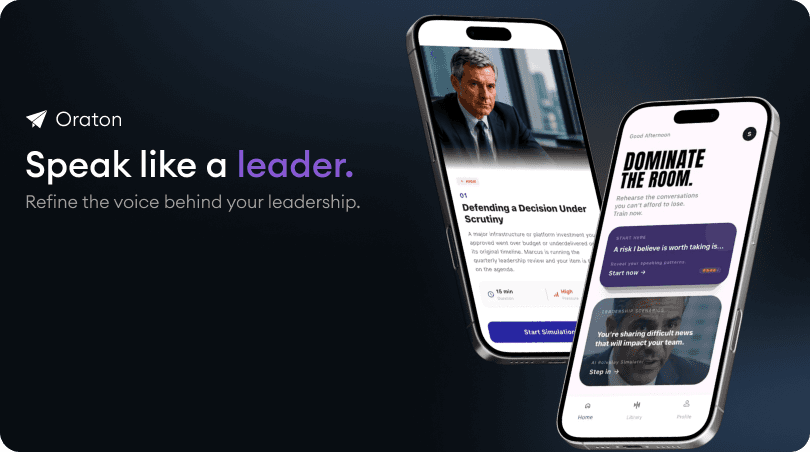
Oraton (www.speakwithoraton.com) is an AI rehearsal app built specifically for executives and founders. Instead of a fixed curriculum, you build practice around your actual upcoming meeting: a Custom Scene builder lets you describe your real situation, and Oraton generates a tailored roleplay with a suggested communication framework (Minto Pyramid, PREP). It also ships with a pre-built Leadership Scenario library (defending a decision under scrutiny, announcing a layoff, retaining a resigning star performer, and more), a Big Stage mode for board and keynote settings, a 60-Second Drill for daily reps, and a dedicated founder pitch-practice mode. Each session is scored on authority, clarity, impact, and structure, with feedback quoting your own speech directly.
What is Yoodli?
Yoodli is an AI-powered speech and communication coaching platform that started as a speech-analytics tool out of Seattle. It has two core modes: real-time coaching, where it runs quietly during live Zoom, Teams, or Google Meet calls and gives private nudges like "slow down" or "cut filler words," and AI roleplay simulations, where you practice interviews, sales calls, or presentations against an AI persona that asks contextual follow-up questions and scores your delivery on filler words, pacing, eye contact, and vocabulary. It's widely used by sales teams and job seekers, and it's the official AI speech-coaching partner of Toastmasters International, which rolled it out to roughly 300,000 members across 149 countries.
Feature comparison: Oraton vs Yoodli
Feature | Oraton | Yoodli |
Core use case | Rehearsing a specific, real upcoming conversation | Real-time meeting coaching + interview/sales roleplay |
Built for | Executives, directors, founders | Sales teams, job seekers, general professionals |
Custom scenario builder | Yes, describe your exact upcoming meeting | Yes, upload your own questions or a job description |
Pre-built leadership scenarios | Yes (layoffs, escalations, retention, pushback, crisis response) | Limited (general interview and sales personas) |
Live, in-meeting coaching | No | Yes, real-time nudges during live Zoom/Teams/Meet calls |
Communication framework guidance | Yes (Minto Pyramid, PREP) | No structured framework guidance |
Board/executive presentation mode | Yes (Big Stage mode) | Not a dedicated mode |
Founder pitch practice | Yes, dedicated mode | Not a dedicated mode |
Daily quick-practice mode | Yes (60-Second Drill) | No equivalent |
Scored feedback categories | Authority, clarity, impact, structure | Filler words, pacing, eye contact, vocabulary, sentiment |
Recordings library | Yes, organized by Topic, Scenario, Best Bets | Yes, session history with analytics |
Team/enterprise management | Not currently a core focus | Yes, SSO, SCIM, audit logs, manager dashboards |
Language support | Not specified as multi-language | English only (as of early 2026) |
Notable partnerships | Not applicable | Toastmasters International, enterprise sales orgs |
Pricing comparison: Oraton vs Yoodli
Oraton offers a 7-day trial for new users. It's positioned as a focused tool for senior leaders rather than a broad consumer app, so pricing centers on individual executive use rather than large team rollouts. Check www.speakwithoraton.com for current plan details.
Yoodli uses tiered, session-based pricing:
Starter (Free): 5 lifetime roleplays, enough for a quick test run.
Pro (~$8/month, billed annually): Up to 10 roleplays per week.
Advanced (~$20/month, billed annually): Unlimited practice and advanced analytics.
Team/Enterprise (custom pricing): Manager dashboards, SSO, SCIM provisioning, audit logs, and data exclusion from AI training.
Yoodli's consumer pricing is notably accessible, which fits its broader job-seeker and individual-professional audience.
Note: Oraton's model reflects a narrower, higher-stakes use case: fewer but more consequential rehearsals rather than high-volume weekly practice.
Scenario and use-case fit
"I have a board meeting next week and need to defend a hard decision." Oraton. Its Big Stage mode and Custom Scene builder are built for exactly this, plus its Leadership Scenario library includes "defending a decision under scrutiny" as a named simulation.
"I want live coaching during my actual sales calls." Yoodli. Its real-time meeting mode runs during live Zoom, Teams, or Meet calls with private, in-the-moment nudges, something Oraton doesn't offer.
"I'm job hunting and want to practice interview answers." Yoodli. Its AI Interview Coach lets you pick a role and industry, answer out loud, and get contextual follow-up questions, backed by a large, established roleplay library and low-cost pricing.
"I need to announce a layoff or restructure and want to get the tone right before I say it out loud to my team." Oraton. This is a named scenario in its Leadership Scenario library, built specifically for the emotional and structural difficulty of this conversation.
"I'm a founder prepping for an investor pitch." Oraton has a dedicated founder pitch-practice mode built separately from its general leadership scenarios. Yoodli's roleplay library covers general sales and presentation practice but doesn't have a pitch-specific mode.
"My company wants to roll out communication coaching to a whole sales team, with manager visibility." Yoodli. Its enterprise tooling (SSO, SCIM, manager dashboards, custom scenario uploads) is built for team-wide deployment in a way Oraton currently isn't.
Who should choose Oraton
Executives, VPs, and C-suite leaders with a specific high-stakes conversation on the calendar
Founders who need to rehearse a pitch specifically, not just general presentation skills
Anyone who wants their practice scored on authority, clarity, impact, and structure rather than just delivery mechanics
Leaders who want a scenario library built around leadership moments (layoffs, escalations, retention, pushback) rather than generic interview or sales practice.
Who should choose Yoodli
Job seekers who want low-cost, high-volume interview practice
Sales reps who want real-time coaching during live calls, not just pre-call rehearsal
Teams and managers who need enterprise rollout, tracking, and compliance features (SSO, SCIM, audit logs)
Toastmasters members or public-speaking learners who want a large, established roleplay library with broad general-purpose coverage
FAQ: Oraton vs Yoodli
Is Oraton better than Yoodli? It depends on the job. For rehearsing a specific, real, high-stakes leadership conversation, Oraton is the more purpose-built tool, since it offers leadership-specific scenarios, framework guidance, and a founder pitch mode Yoodli doesn't have. For real-time coaching during live meetings, or broad, low-cost interview and sales practice, Yoodli is the stronger fit.
Does Yoodli work in real time during live calls? Yes. Yoodli can run during live Zoom, Google Meet, or Microsoft Teams calls and give private, in-the-moment nudges. Oraton doesn't offer live in-meeting coaching; it's built for pre-meeting rehearsal instead.
Does Oraton have a free trial? Oraton offers a 7-day trial. Yoodli has a permanent free tier limited to 5 lifetime roleplays, plus paid tiers starting around $8/month.
Can Yoodli help with board meeting prep? Yoodli's general roleplay and presentation practice can help with delivery basics, but it doesn't have a dedicated board-presentation mode or leadership-specific scenario library the way Oraton's Big Stage mode and Leadership Scenario library do.
Which tool is better for a founder preparing an investor pitch? Oraton, because it includes a dedicated founder pitch-practice mode built separately from general presentation practice. Yoodli's roleplay library covers general sales and presentation scenarios but has no pitch-specific mode.
Is Yoodli or Oraton better for enterprise team rollout? Yoodli, currently. Its enterprise tier includes SSO, SCIM provisioning, audit logs, and manager dashboards for tracking team-wide progress, features built for scaling coaching across a sales org or company.
Bottom line
Oraton and Yoodli solve different problems well. If your gap is a specific, upcoming, high-stakes leadership conversation, a layoff announcement, a board defense, an investor pitch, Oraton's scenario-specific rehearsal is the more precise tool. If your gap is ongoing delivery coaching during live meetings, or broad, affordable interview and sales practice, Yoodli is the stronger, more established choice.
Try Oraton: www.speakwithoraton.com



Previous

The hardest part of responsible AI isn't writing the framework. It's building an organization capable of testing AI in reality, learning from failure and knowing when humans need to intervene.
Next

Obama's 2009 Prague speech offers a masterclass in leadership communication. Rather than leading with facts and policy, Obama first built belief in a future that seemed impossible…