•
6 Min Read





Key Summary
At more than $4 trillion in market value, most CEOs would be expected to operate from a distance. Jensen Huang does the opposite. He has 60+ direct reports and avoids one-on-one meetings altogether.
Nvidia nearly ran out of payroll in the late 1990s, surviving thanks to a $5 million investment from Sega. Three decades later, Huang still runs the company as if it has only 30 days left to survive.
Long before ChatGPT, Nvidia made bets on AI and scientific computing that many considered irrational. The article explores why Huang sees success itself..not competition, as the greatest threat.
While most leadership advice teaches executives how to scale authority, Huang seems obsessed with something else entirely. And that obsession may explain how a company founded in a Denny's booth became one of the most valuable businesses in history.
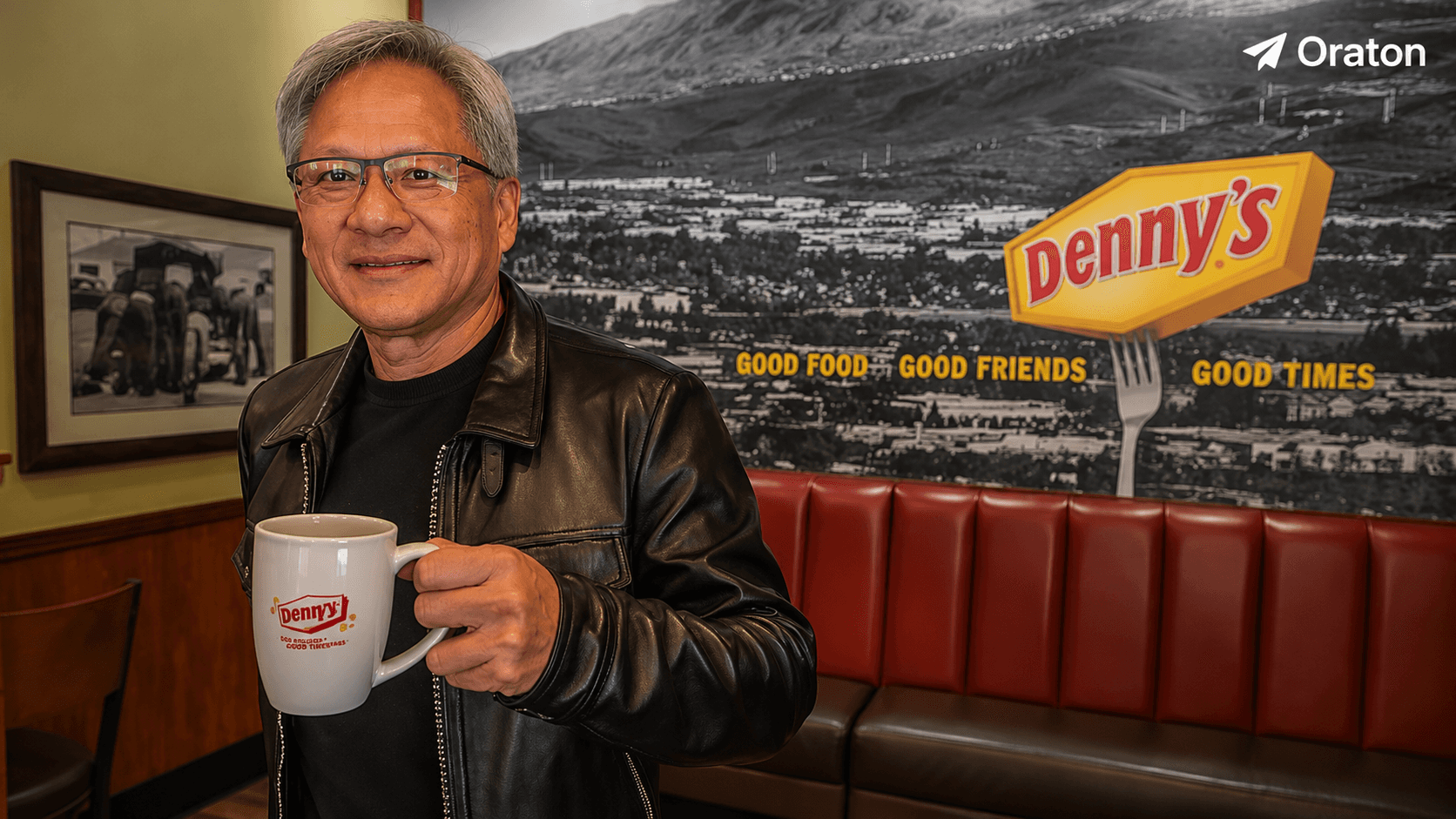
By the time Nvidia crossed a $4 trillion valuation and Jensen Huang became one of the most influential executives in the world, most people expected to find a leader who looked remarkably different from the entrepreneur who had started the company in a Denny's booth in 1993.
Success, after all, usually changes leaders.
As organizations become larger, hierarchies become deeper. Layers multiply. Information gets filtered. CEOs become increasingly insulated from the details of the business. The organization grows, and with it, the distance between the person at the top and the people doing the work.
Jensen Huang appears to have taken the opposite path.
Despite leading one of the most valuable companies in history, Huang has more than sixty direct reports and famously avoids one-on-one meetings altogether. Problems are discussed collectively. Engineers, executives, and specialists reason through issues together. He has described the process as "extreme co-design," arguing that everyone should have access to the same information and the same conversations. In his view, CEOs should have the most direct reports because they are in the best position to inspire and empower others.
At first glance, this seems almost absurd. For decades, management theory has taught executives to delegate, create layers, and scale through hierarchy. Most leadership textbooks would view sixty direct reports as a recipe for chaos. Conventional wisdom suggests that leaders become effective by narrowing their span of control.
Huang appears to believe the opposite.
And that belief reveals something much deeper about how he thinks. Because underneath the unconventional org charts and unusual meetings lies a leadership philosophy built around one idea:
Distance is dangerous.
Most companies do not become slow because their people become less talented. They become slow because information begins to travel through filters. Every layer modifies reality slightly. Every summary removes context. Every presentation smooths over uncomfortable details. Eventually, leaders start operating on abstractions rather than truths. Huang? He has spent much of his career trying to eliminate those abstractions.
According to reports, one of his favorite mechanisms is the "Top-5 Things" email, where employees send observations, concerns, and developments directly to him. Rather than relying solely on dashboards and presentations, Huang prefers raw information. He wants weak signals. He wants anomalies. He wants to know what people closest to the work are seeing before those observations become sanitized by bureaucracy.
This instinct may explain one of Nvidia's most remarkable qualities. The company has behaved less like a mature incumbent and more like a startup experiencing perpetual existential anxiety.
In the late 1990s, Nvidia came within one month of running out of payroll. A $5 million investment from Sega helped keep the company alive. Huang later made "we are thirty days from going out of business" something of an unofficial company motto. Decades later, even after Nvidia became one of the biggest winners of the AI revolution, the mindset remained. That mindset is fascinating because it violates one of the most dangerous assumptions in leadership.
Namely, that success creates security. Huang appears to believe the opposite. Success creates complacency and complacency creates vulnerability.
This helps explain why Nvidia repeatedly made bets that looked irrational at the time. In 2006, when most people still viewed GPUs primarily as gaming hardware, Nvidia began investing heavily in CUDA and scientific computing. Years before ChatGPT transformed public awareness of artificial intelligence, Huang had concluded that deep learning represented the future and repositioned the company accordingly. Former executives recall that one Friday evening he announced that Nvidia was becoming an AI company. By Monday morning, everyone was operating under a completely different assumption.
Seen through that lens, Huang's leadership style starts to make more sense. He does not optimize for comfort. He would rather optimize for adaptability.
This may also explain why he dislikes traditional corporate hierarchies. Huang has criticized what he calls the "hamburger" organizational structure, where information flows upward through layers before eventually reaching senior leadership. To him, those structures create delay, dilute accountability, and reduce the quality of decision-making. What is particularly interesting is that his philosophy runs counter to many assumptions associated with executive presence.
Most leaders rise by projecting certainty. They are expected to appear calm, composed, and in control. Success often encourages executives to believe they possess superior answers.
Huang, however, seems to derive strength from a different source.
Paranoia.
Not destructive paranoia, but productive paranoia.
Andy Grove, the legendary Intel CEO, once wrote that only the paranoid survive. Huang appears to have internalized that principle more deeply than almost anyone in Silicon Valley. His organization behaves as though disruption is always around the corner, competitors are always improving, and today's advantages are temporary. Ironically, that anxiety may be one of Nvidia's greatest assets.
Because history is littered with companies that became victims of their own success. Kodak understood digital photography. Nokia understood smartphones. Blockbuster understood streaming. Their problem was not intelligence. It was confidence. Their previous victories convinced them that tomorrow would resemble yesterday.


Huang seems determined never to make that mistake. Perhaps the most surprising aspect of his leadership style is that it rejects status itself. Nvidia executives are known for unusually modest perks, and senior leaders often travel without the privileges associated with companies of comparable scale. Employees describe a "one team" culture where hierarchy matters less than contribution.
That culture reflects a belief that leadership is not about creating distance. It is about eliminating it. And this may be the deeper lesson executives should take from Jensen Huang's example. Leadership literature often teaches leaders how to scale authority.
Huang seems more interested in scaling awareness. He wants information to move faster. He wants ideas to collide more frequently, meaning fewer filters between problems and decisions.
Most importantly, he wants Nvidia to retain the psychology of a startup long after it has ceased to resemble one.
That may sound paradoxical. But perhaps every great company eventually faces the same challenge.
The question is not whether success will change the organization. It inevitably will.
The question is whether leaders can prevent success from changing the assumptions that made the organization successful in the first place. 30+ years after founding Nvidia, Jensen Huang still behaves like a man whose company has thirty days left.
And that may be precisely why it never does.
Previous

Keir Starmer's challenge wasn't simply improving relations with Europe. It was ensuring that the strategy remained credible even if the person leading it changed.
Next

Jacinda Ardern's pandemic leadership offers a lesson that extends far beyond COVID-19. In moments of uncertainty, trust, empathy, and shared purpose can matter as much as strategy itself.