•
Reading Time: 11 minutes





Last Updated: July 2026
Quick Answer: Psychologist Daniel Goleman identified six leadership styles: coercive, authoritative, affiliative, democratic, pacesetting, and coaching, each rooted in a different mix of emotional intelligence skills. No single style works in every situation. The most effective leaders switch between styles based on what a moment demands, using directive styles like coercive and pacesetting sparingly and relationship-building styles like coaching, authoritative, democratic, and affiliative as their default.
Table of Contents
What Are Goleman's Six Leadership Styles?
Where the Framework Comes From
The Six Styles Explained
Does Goleman Recommend Picking Just One Style?
How Leadership Style Shapes Company Culture
Managing Each Style: Strengths, Risks, and Fixes
Goleman Styles vs. Other Leadership Models
Common Mistakes When Applying the Framework
Building a Well-Rounded Leadership Style
FAQs
Conclusion
What Are Goleman's Six Leadership Styles?
Being the boss and being a leader aren't the same thing. A manager can hold the title, the org chart position, and the salary, and still fail to get people to actually follow them.
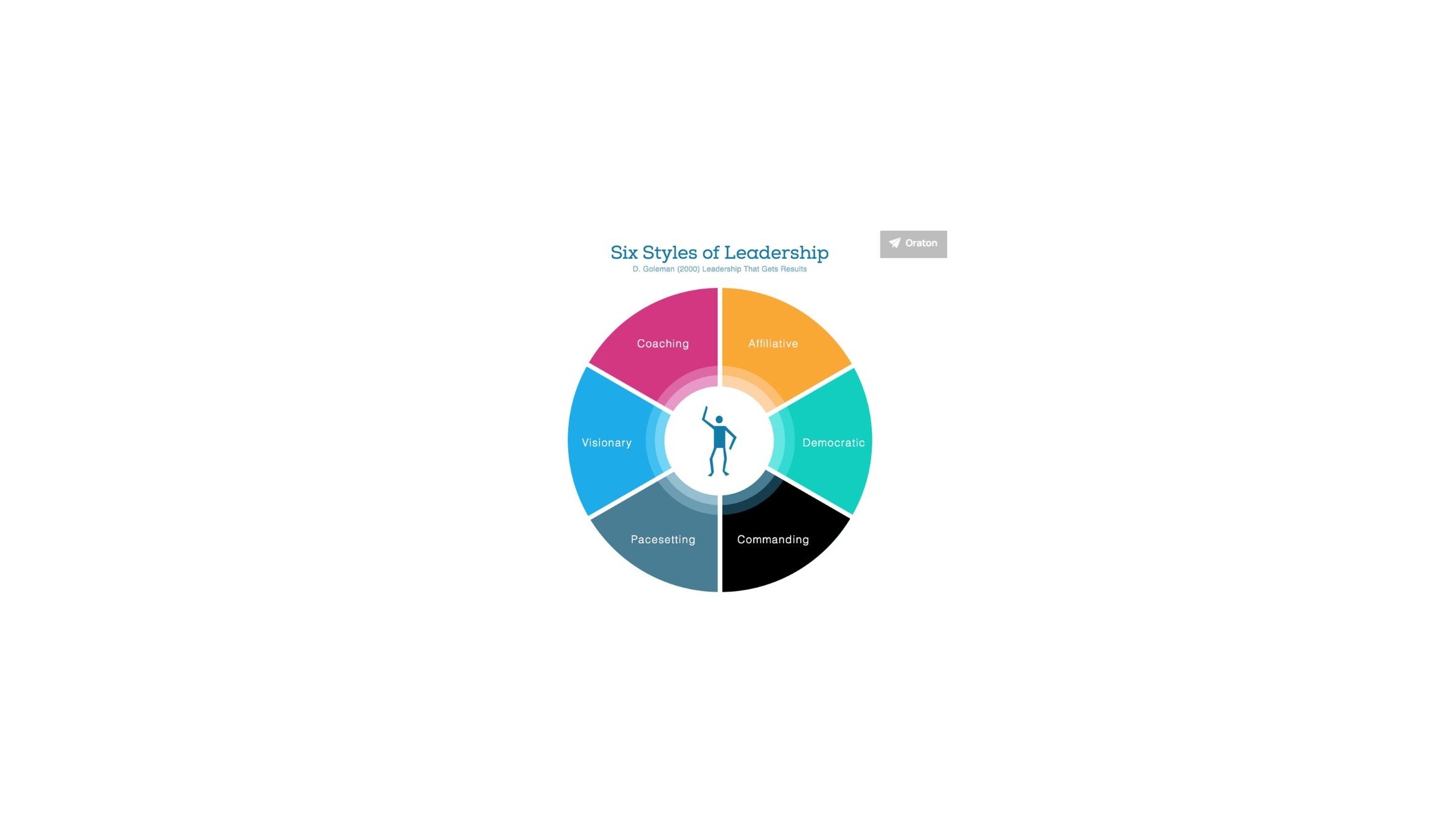
Psychologist Daniel Goleman built his six leadership styles around that gap. Each style draws on a different combination of emotional intelligence competencies: self-awareness, self-regulation, motivation, empathy, and social skill. Each style arises from a different component of emotional intelligence, and each has a measurably different effect on team morale, retention, and output.
The six styles are:
Coercive (also called commanding or directive)
Authoritative (also called visionary)
Affiliative
Democratic (also called participative)
Pacesetting
Coaching
Where the Framework Comes From
In 2000, psychologist Daniel Goleman, best known for popularizing the concept of emotional intelligence, published an article in the Harvard Business Review titled "Leadership That Gets Results," in which he outlined six leadership styles that promised to take the mystery out of effective leadership. The styles emerged from a survey conducted by consulting firm Hay/McBer of thousands of executives, tied to Goleman's own research on emotional intelligence.
The scale of the underlying research is part of why the framework has held up for over two decades. Goleman drew on research covering more than 3,000 executives to explore which precise leadership behaviors produced positive business results, and found that each style springs from a different component of emotional intelligence and has a distinct effect on the working atmosphere of a team, division, or company, and, in turn, on its financial performance.
This isn't a personality test. Goleman's central claim is that style is a choice, not a fixed trait, which is why the framework is used in leadership development programs rather than filed alongside personality inventories like Myers-Briggs.
The Six Styles Explained
1. Coercive Leadership Style
Also known as commanding leadership, this is the "do what I say" approach. It works by demanding immediate compliance.
Best used for: Crisis situations, a data breach, a compliance failure, a difficult employee who needs a direct intervention, or any moment where speed matters more than buy-in.
Watch out for: Used as a daily default, coercive leadership erodes psychological safety fast. Employees stop bringing forward problems or new ideas because they've learned their input isn't wanted.
2. Authoritative Leadership Style
Sometimes called visionary leadership, this style sets a clear destination and then gets out of the way. The leader defines the "what" and the "why": the team decides the "how."
Best used for: Situations that need direction and motivation, especially when a team has lost sight of the bigger picture. Of the six styles, this one is most consistently linked to positive team climate.
Watch out for: Authoritative leaders can tip into micromanaging the outcome even while claiming to give autonomy over the process, which undercuts the very trust the style is supposed to build.
3. Affiliative Leadership Style
Affiliative leaders prioritize relationships and emotional bonds. They're generous with praise, invest in one-on-ones, and work hard to keep morale high.
Best used for: Rebuilding trust after conflict, healing a team following a merger or layoff round, or any period where cohesion matters more than short-term output.
Watch out for: Affiliative leaders often avoid corrective feedback altogether. Praise without honest input leaves employees unsure where they actually stand, which stalls growth rather than supporting it.
4. Democratic Leadership Style
Also called participative leadership, this style pulls the whole team into decision-making. Everyone's voice genuinely factors into the outcome.
Best used for: Complex decisions where the leader needs input from people closer to the work, or when building long-term buy-in matters more than short-term speed.
Watch out for: Democratic leadership is a poor fit for emergencies, it takes time to gather input, and endless meetings without a final decision can burn out a team and quietly erode the leader's authority.
5. Pacesetting Leadership Style
The pacesetter leads by example, setting a high personal bar and expecting the team to match it.
Best used for: Teams of self-motivated, highly skilled experts who need minimal oversight and thrive on high standards.
Watch out for: Of all six styles, pace-setting is the one most likely to backfire. Standards set too high, too fast, leave employees feeling like they can never measure up, and pacesetters often respond by taking over the work themselves rather than developing their team.
6. Coaching Leadership Style
Coaching leaders focus on long-term development over short-term output. They work one-on-one with employees to build skills and confidence.
Best used for: Employees who are motivated to grow and want ownership over their own development path.
Watch out for: Coaching takes time, real time, spent one-on-one, which is exactly why it's the least-used of the six styles in practice. Rushed or half-hearted coaching reads as insincere and can damage trust rather than build it.
Internal Link Opportunity: How to Give Constructive Feedback That Actually Lands
Does Goleman Recommend Picking Just One Style?
No, and this is the part of the framework most people misunderstand. The research indicates that leaders who get the best results don't rely on just one leadership style; they use most of the styles in any given week. Goleman put it directly: the best leaders don't know just one style of leadership; they're skilled at several, and have the flexibility to switch between styles as circumstances dictate.
A practical example: if a company were bleeding clients week after week, a coercive leader stepping in to stop the damage would make sense. Once the immediate crisis is resolved, though, staying in coercive mode would wreck the client relationships the company just fought to save, that's the moment to shift into authoritative leadership, giving the team clear direction while rebuilding trust.
How Leadership Style Shapes Company Culture
Goleman's own research points to a clear split. Coercive leadership is effective in a crisis or with problem employees but can stifle innovation and reduce team morale when overused. Pace-setting carries similar risk when applied as a permanent default rather than a situational tool. The other four styles, coaching, authoritative, affiliative, and democratic, build collaboration and put employee input at the center, which tends to strengthen culture over time.
The stakes of getting this wrong are larger than they might seem.
Trust is falling, and it's dragging engagement down with it. Only one in three employees worldwide strongly agree that they trust the leadership of their organization, according to Gallup's State of the Global Workplace research. Some 2025 industry surveys put the number even lower, one report found just 20% of U.S. employees strongly trust their leadership, with confidence in direct managers not much higher.
Disengagement has a real, measurable price tag. Gallup estimates that declining engagement cost the global economy $438 billion in lost productivity in 2024 alone, and the cost of disengagement in the U.S. is now approximately $2 trillion in lost productivity. Globally, employee engagement dropped from 23% to 21% between 2024 and 2025, the sharpest year-over-year drop since the COVID-19 lockdowns.
Managers are the single biggest lever available. Gallup's research consistently finds that roughly 70% of the variance in team engagement is directly attributable to the manager, which is precisely why leadership style, not just leadership talent, is worth taking seriously as a lever for culture change.
Toxic leadership carries a national economic cost, and it's climbing. In the UK, toxic workplace culture was estimated to cost the economy around £15.7 billion a year in 2020. By 2023, a follow-up estimate put that figure at £23.6 billion per year; a trend that tracks with rising resignation rates tied to culture rather than pay.
None of this means coercive or pace-setting leaders are "bad" leaders. It means those two styles carry the highest cultural cost when they become a leader's only mode, rather than one tool in a larger kit.
Managing Each Style: Strengths, Risks, and Fixes
Style | Where It Shines | What Can Go Wrong | What HR Can Do |
|---|---|---|---|
Coercive | Emergencies, high-pressure fixes, underperforming employees | Damages morale; team stops raising ideas or concerns | Limit use to genuine emergencies; debrief with the team once the crisis passes |
Authoritative | Giving direction, connecting people to a bigger mission | Can become overbearing while chasing the vision | Protect team autonomy on the "how"; keep leader focused on outcomes, not methods |
Affiliative | Rebuilding morale, healing team relationships | Avoids hard feedback; growth stalls | Pair with authoritative or coaching input so praise comes with direction |
Democratic | Complex decisions, building long-term buy-in | Meeting overload; slow decisions; erodes authority | Cap meeting length/frequency; require a clear final call from the leader |
Pacesetting | Self-motivated expert teams with proven track records | Unrealistic standards; leader takes over rather than delegates | Set goals that are ambitious but achievable; check in on workload regularly |
Coaching | Developing high-potential employees long-term | Rarely used well due to time constraints | Protect time on leaders' calendars specifically for coaching; set measurable development goals |
Managing a Coercive Leader
Coercive leaders do their best work in a genuine emergency — a situation where a fast, unilateral call is the only thing that will work. The risk is a leader who never leaves that mode. HR's job is to make sure coercive leadership stays the exception: build a re-entry plan for after the crisis, and check in individually with team members who may have felt sidelined during it.
Managing an Authoritative Leader
This is generally the most effective of the six styles on its own, largely because it combines clear direction with genuine autonomy. The risk is a leader who states a vision but then can't resist controlling every step toward it. HR support here means protecting team ownership of execution and keeping the leader's attention on the destination, not the route.
Managing an Affiliative Leader
Affiliative leadership is the fastest way to repair a damaged team dynamic — these leaders build trust and connection quickly. The tradeoff is that difficult conversations get avoided. Pairing an affiliative leader with a more directive counterpart, or explicitly coaching them on delivering critical feedback, keeps the warmth without sacrificing growth.
Managing a Democratic Leader
Democratic leaders build genuine buy-in by treating input as real, not performative. This works well when there's time to gather perspectives and the leader trusts the team's judgment. It works badly under time pressure. HR can help by setting meeting limits and coaching the leader to make the final call rather than seeking endless consensus.
Managing a Pacesetting Leader
Pacesetters lead by example and get the most out of teams that are already highly skilled and self-directed. The failure mode is standards set so high that people quietly give up trying to meet them, or a leader who starts doing the work themselves rather than trusting the team. HR should help pacesetters set goals that stretch the team without breaking it.
Managing a Coaching Leader
Coaching leadership produces some of the strongest long-term results, but only when the leader has real time to invest. Rushed coaching feels hollow and can do more harm than no coaching at all. Give coaching-oriented leaders protected time, a structured development plan, and permission to say no to lower-priority tasks so the coaching isn't the first thing cut.
Internal Link Opportunity: How to Build a Manager Development Program
Goleman Styles vs. Other Leadership Models
Goleman's framework is often taught alongside other leadership models, and it's worth knowing how they differ:
Framework | Core Idea | Best For |
|---|---|---|
Goleman's Six Styles | Style is a situational choice rooted in emotional intelligence | Adapting leadership approach moment to moment |
Situational Leadership (Hersey-Blanchard) | Leadership style should match the follower's competence and commitment level | Managing individuals at different skill/experience stages |
Transformational Leadership | Leaders inspire change through vision and personal influence | Driving large-scale organizational change |
Servant Leadership | The leader's role is to serve the team's needs first | Building long-term trust and employee-first cultures |
Goleman's model overlaps most with transformational leadership (both value vision and inspiration) but is distinct in its emphasis on switching styles deliberately rather than committing to one philosophy of leadership.
Common Mistakes When Applying the Framework
Treating it as a personality test. The six styles describe behaviours, not fixed traits. A leader isn't "a pacesetter" the way they might be an introvert, they're someone who currently defaults to pace-setting and can learn to use other styles.
Overusing coercive or pace-setting styles outside emergencies. These are the two styles Goleman's research links most clearly to damaged team climate when used as a default rather than a tool.
Assuming "positive" styles have no downside. Affiliative and democratic leadership feel more pleasant day to day, but overused, they create their own problems, avoided feedback and meeting fatigue, respectively.
Skipping the debrief after a coercive intervention. Teams that go through a high-pressure, directive period need a deliberate transition back to normal operating style, or trust erodes even after the crisis passes.
Building a Well-Rounded Leadership Style
As leadership author Simon Sinek puts it: "A boss has the title, a leader has the people." Most leaders naturally default to one or two of Goleman's six styles. The leaders who get consistently strong results are the ones who deliberately build fluency in the others, treating style as a toolkit they can reach into, rather than a single setting they're stuck on.
For HR teams, that means building leadership development programs that go beyond generic "communication skills" training and instead teach leaders to diagnose a situation and choose a style deliberately: crisis calls for coercive, direction-setting calls for authoritative, team-building calls for affiliative, complex decisions call for democratic, expert teams call for pacesetting, and long-term growth calls for coaching.
FAQs
What are the six leadership styles by Goleman? Coercive, authoritative, affiliative, democratic, pacesetting, and coaching. Each style draws on a different mix of emotional intelligence skills and fits a different business situation.
Which Goleman leadership style is most effective? There's no single "best" style, effectiveness depends on context. That said, Goleman's research links authoritative leadership to consistently positive team climate, while coercive and pace-setting are the two styles most likely to damage morale when overused.
Can a leader use more than one style? Yes, and Goleman's research suggests they should. Leaders who get the best results use most of the six styles in a given week rather than sticking to one.
Is coercive leadership always bad? No. It's genuinely useful in a real crisis, a serious performance issue or an urgent business threat. The problem is using it as a everyday default, which research links to lower morale and reduced innovation.
How do I know which style I default to? Look at your last few tough calls. Did you dictate the solution, set a vision and step back, focus on team harmony, seek group input, model the standard yourself, or invest in someone's long-term growth? Whichever pattern shows up most often is likely your default style — and probably the one worth deliberately balancing with another.
Conclusion
Goleman's six leadership styles aren't a box to sort leaders into, they're a set of tools every leader can learn to use. The gap between a good manager and a genuine leader usually isn't talent or title. It's the ability to read a situation and deliberately switch styles: stepping into coercive mode during a real crisis, then moving to authoritative or coaching once the fire is out.
For HR teams, the practical next step is building that switching ability into leadership development, not as a one-off workshop, but as an ongoing practice tied to the real conversations leaders face every day. Given how closely trust, engagement, and leadership effectiveness are linked to organizational performance, it's an investment that compounds over time.
At Oraton Executive Communication Coach, we help leaders practice exactly those moments. Through AI-powered simulations, leaders can rehearse difficult conversations, adapt their communication style to different stakeholders, and build the judgment, confidence, and executive presence needed to lead effectively before those conversations happen in the real world. Because great leadership isn't defined by knowing every style, it's defined by knowing when and how to use each one.
Sources
Goleman, D. (2000). "Leadership That Gets Results." Harvard Business Review, 78(2), 78–90.
Gallup, State of the Global Workplace: 2025 Report - gallup.com
Gallup, "Anemic Employee Engagement Points to Leadership Challenges" -gallup.com/workplace/692954
Breathe HR, The Culture Economy reports (2020–2023) on the cost of toxic workplace culture to the UK economy
SUCCESS, "How Do You Lead? Understanding the 6 Leadership Styles" - success.com



Previous

Learn when hedging language builds credibility and when it weakens your message. Discover how executives, researchers, and business leaders use certainty and caution to communicate more effectively.
Next

Germany's World Cup exit was more than a football disappointment. It reopened an enduring leadership question about innovation, institutional memory, and the price organizations pay when they disrupt long-standing traditions.