•
5 Mins Read.

Disclosure: Oraton makes an AI articulation coach, so we have a stake in this topic. We've written this guide to be useful whichever tool you choose, and we cite public sources throughout. Vendor features change quickly, so check current details with each provider.
Search for "best AI coach" and you'll find dozens of ranked lists, nearly all written by the vendors they rank. They tend to agree on one thing: the author's product comes first. That makes it hard to tell what actually matters when you choose a tool.
This guide takes a different approach. Instead of ranking products, it gives you ten questions to ask, a way to test any tool in an afternoon and a map of the categories of AI coaching so you can tell what kind of tool you're looking at.
The short version: Decide what job you need done (reflection, rehearsal, speech feedback or team-wide skill building), then judge tools on how they behave, not how they're marketed. Test them with an ambiguous scenario, check how they handle privacy and escalation, and look for evidence beyond ratings and engagement. Many leaders end up combining an AI coach for practice with a human coach or mentor for context.
In this guide
Start with the job, not the product
A map of the AI coaching landscape
Ten questions to ask before you choose
A one-afternoon test
A simple scoring sheet
Where Oraton fits
Frequently asked questions
Start with the job, not the product
The word "coach" covers very different things. Before you compare tools, name the main job you want done:
Reflection: thinking through a situation, such as a difficult meeting or a decision.
Rehearsal: practising a conversation before it happens.
Speech feedback: getting objective analysis of how you sound, such as pace, clarity and filler words.
Ongoing habit-building: short, regular prompts that keep a skill in mind.
Programme-wide development: structured skill building across a team, with reporting.
A tool that excels at one may be mediocre at another. A comparison from the coaching provider Torch makes the same point, advising readers to decide which connection a programme needs, whether that's rehearsal, a learning resource or a human coach, before comparing features.
A map of the AI coaching landscape
AI coaching tools fall into several rough categories. The examples below are drawn from the vendors' own product pages and public comparison guides, and they illustrate the categories rather than rank anyone.
Category | What it does | Examples |
AI layered on human coaching | An AI companion for reflection and practice between human coaching sessions | |
AI-only leadership coach | Always-on AI guidance for managers, with no human coach in the model | |
Real-time speech feedback | Analyses your speaking during or after live calls | |
Speech and presentation practice | Record yourself and get feedback on delivery and content | |
AI role-play and team learning platforms | Scenario practice, content creation and analytics for L&D teams | Shiken and similar platforms |
Daily leadership tips and AI chat | Short prompts and an AI coach inside a mobile app |
Many products straddle categories, and descriptions change. Treat this as a starting point for your own research.
Ten questions to ask before you choose
1. What is the job, and who is it for?
Name the user (a CEO, a first-time manager, a sales team) and the job. A platform built for manager populations may thin out at the executive level, and vice versa. Growthspace's comparison guide raises the same point about level coverage, though it's written by a competitor, so weigh it accordingly.
2. How does it give feedback: real time or structured practice?
Bunch's guide to workplace communication coaches distinguishes real-time feedback during live conversations from structured practice sessions such as role-play. Real-time tools help you adjust in the moment, while structured practice builds the skill first. Many people need both.
3. Does it ask before it advises?
A good coach checks what actually happened before accepting your interpretation. Torch's guidance suggests testing this directly: begin with an ambiguous situation, like "my employee is disengaged," and see whether the tool asks for observations before recommending action.
4. Is the feedback specific to you?
Generic tips are everywhere. Look for feedback tied to your actual speech or situation, and for suggestions you can act on next time.
5. Is practice voice-based or text-only?
If your goal is better speaking, practise speaking. Text conversations help with thinking, but they don't train pace, pauses, clarity or tone.
6. What happens to your data?
Ask what you can enter, who can see it, how long it's kept, whether it's used to train models and how you delete it. We cover this in is AI coaching private and safe?
7. What happens when the AI doesn't know?
Growthspace suggests asking the AI something it shouldn't know during a demo, because a platform that guesses confidently will do the same with your managers. Also ask how the tool routes sensitive topics to a human.
8. How is progress measured?
Look for progress across sessions on specific skills, not just completion or ratings. Engagement shows people like a tool, not that their behaviour changed.
9. What does the evidence say?
Ask for specific research, including who participated, what the comparison group was and what was measured. We summarise the state of the evidence in does AI coaching work?
10. What does it really cost, and what's included?
Pricing is often custom. Compare on the same basis: number of users, time period, standalone access versus bundled human coaching, and any configuration work.
A one-afternoon test
You can learn more from 90 minutes of testing than from any feature list.
Ambiguity test (20 minutes). Present an unclear situation and see whether the tool asks good questions.
Correction test (10 minutes). Give it a wrong summary of what you said, and see whether it adjusts.
New-information test (10 minutes). Add a fact midway and watch how it adapts.
Speaking test (20 minutes). Record a two-minute update. Is the feedback specific, accurate and actionable?
Next-step test (10 minutes). Does the tool lead to a rehearsal, a resource or a human?
Failure test (10 minutes). Ask something it shouldn't know and see whether it admits uncertainty.
Admin check (10 minutes). Read the privacy terms and find out how to delete your data.
These steps adapt the approach Torch recommends for testing the conversation, not the model.
A simple scoring sheet
Score each tool from 1 (weak) to 5 (strong). Weight the rows that matter most to you.
Criterion | Tool A | Tool B | Tool C |
Fits the main job | |||
Asks before advising | |||
Specific, accurate feedback | |||
Voice-based practice (if relevant) | |||
Privacy and data control | |||
Handles uncertainty and escalation | |||
Progress tracking | |||
Evidence offered | |||
Total cost for your use |
Where Oraton fits
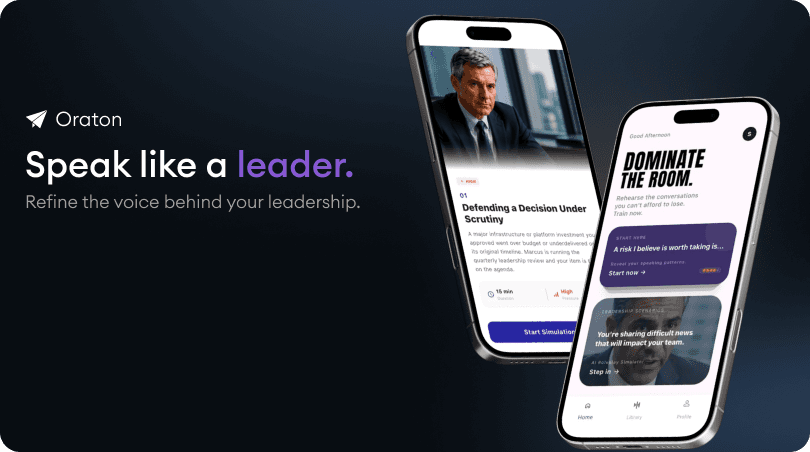
Oraton is an AI articulation coach designed for leaders who want to improve how they sound when it matters. According to its product page, you record practice answers and get feedback on articulation, clarity, pace, filler words, hedging and structure, with a short speech test for a baseline and a repeat-practice mode. It's built for private practice of the delivery layer of communication.
For a hands-on comparison, see our test of AI communication coaches for executives. For how AI practice fits with other formats, see executive presence training: what to look for.
Frequently asked questions
What is the best AI communication coach?
It depends on the job. A tool for speech delivery, one for role-play across a sales team and one for manager reflection are different products. Define the job first, then test two or three tools against it.
How is an AI coach different from a chatbot?
A dedicated coach typically adds structure, such as rubrics, voice practice, progress tracking and privacy controls. See AI coach vs ChatGPT for leaders.
Should I choose an AI coach or a human coach?
Often both. AI is useful for frequency and rehearsal, while human coaches add context, challenge and accountability. See AI coaching vs human coaching.
Can AI coaching help non-native English speakers?
It can offer a private space to rehearse and refine phrasing and pace. Check language support and whether feedback separates accent from clarity. See how to make your accent easier to understand at work.
How do I know if it's working?
Compare a baseline recording with later ones, and look for changes in real meetings, not just in the app.
Key takeaways
Name the job first: reflection, rehearsal, speech feedback, habit-building or programme-wide development.
Judge tools by behaviour. Test with ambiguous cases, corrections, new information and failure.
Check privacy, escalation and evidence as carefully as features.
Compare costs on the same basis.
Combine AI practice with human insight where context matters.
To test a speaking-focused coach yourself, try Oraton's AI articulation coach and compare it against your checklist.
Sources
Growthspace: AI-powered leadership coaching platforms comparison
Shiken: 9 best AI communication coaching platforms for L&D teams
Vendor product pages linked in the table above
Note: the comparison guides above were written by vendors who feature their own products. We used them for definitions, criteria and descriptions of categories, not for rankings.
Related articles