The YC Interview: What to Expect and How to Actually Prepare
Quick Answer: A Y Combinator interview is a 10-minute Zoom call with 2 to 3 partners, and YC's own guidance is blunt: don't over-rehearse. The best preparation is making real progress on your startup between applying and interviewing, being able to explain what you do in plain language, and knowing your metrics cold. Founders who've been through it add a few more specifics: get the first question right, expect the toughest scrutiny on your weakest point, and don't read too much into how the call felt afterward.
Table of contents
1. What actually happens in the interview
2. What YC itself says to do
3. What YC says not to do
4. What founders who’ve been through it add
5. Nail the first question
6. The wildcard question
7. A rough scoring framework before you even apply
8. Is YC actually worth it?
9. Common mistakes
10. FAQs
11. Conclusion
What actually happens in the interview
A YC interview runs exactly 10 minutes over Zoom, with all co-founders expected on the call and typically 2 to 3 partners on the other end. Founders often report waiting in a virtual room for several minutes past their scheduled time, which makes sense given how many interviews YC runs on a single day. There's no small talk and no formal introduction. The partners have your application open in front of them and start asking questions immediately, usually led by one primary interviewer while others jump in as the conversation develops.
Then it's over just as abruptly. You'll typically hear back within 24 hours: an email if the answer is no, a phone call from your lead interviewer if it's yes. Founders who've been through the process describe the wait as genuinely difficult, and multiple accounts confirm there's no predictable pattern to when the answer arrives; rejection emails and acceptance calls have both landed anywhere from late evening to the following morning.
What YC says to do
Y Combinator's own interview guide is refreshingly direct about what actually helps, and it starts by pushing back on the instinct to over-prepare.
Make real progress instead of rehearsing. YC's guidance states plainly that beyond basic preparation, extensive rehearsal isn't useful and can actually work against you. The stronger move is spending the time between your application and your interview shipping something: launching, improving the product, growing revenue. Visible momentum in that window is, in YC's own words, one of the most reliable ways to impress interviewers.
Be ready to explain what your company does, simply. The first question is almost always some version of "what are you working on," and YC notes that a surprising number of founders struggle to answer it clearly despite having written about their company at length in the application. A few plain, jargon-free sentences work better than a polished pitch.
Know your users and your numbers. If you've launched, YC expects real fluency with your metrics: where users come from, how fast you're growing, whether people stick around, and what your unit economics look like. You don't need every number memorized, but having them written down nearby removes the pressure of live recall, and YC notes they may ask you to verify any figures you cite after the call.
Be candid about obstacles, not defensive about them. YC's guidance is explicit that a candid discussion of real difficulties lands better than pretending there aren't any. Acting like your startup has no obstacles reads as having overlooked them, not as confidence.
Have a working demo ready if you've built something. Software should be loaded and ready to screen-share. Hardware should be physically in the room or shown on video. This isn't optional if a working version exists.
Make sure every founder gets airtime. YC states a preference for each founder answering at least one question directly, which means preparing shouldn't be a one-person job even if one founder naturally leads the conversation.

What YC says not to do
The clearest signal in YC's own guidance is what they explicitly discourage: heavy rehearsal beyond the basics. Overly polished, memorized answers can come across as scripted rather than sincere, and YC frames sincerity, straightforwardness, and natural conversation as exactly what they're trying to assess, since these are the same people you'd work with after acceptance.
What founders who’ve been through it add
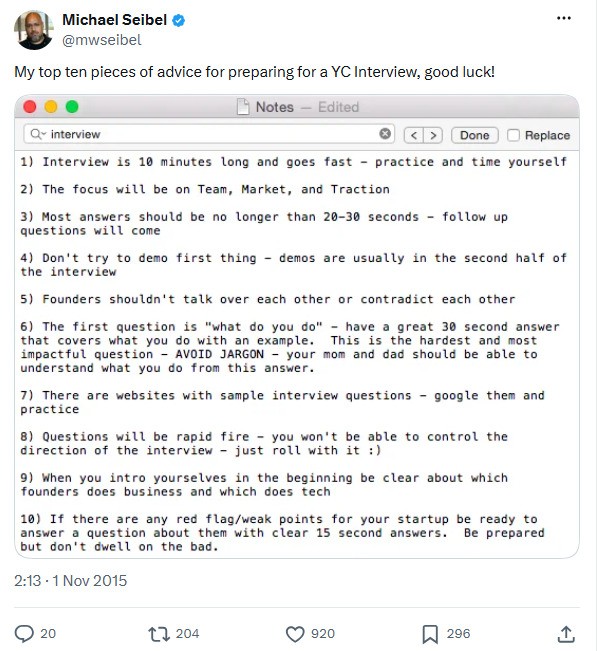
YC's official guidance covers the fundamentals, but founders who've actually sat through the interview add texture that's worth knowing, even where it goes slightly beyond YC's own framing.
Anchor your explanation to something familiar. One founder who succeeded on his fourth attempt after three rejections credits a specific technique: describing his product as "like Zapier, but if Zapier is a calculator, we're Wolfram Alpha." Comparing your product to something the interviewer already understands, rather than describing it in the abstract, creates the instant clarity YC is explicitly looking for in that first answer.
Expect the interview to probe your weakest point, not your strongest. Multiple founders report that partners consistently steer toward the shakiest part of the business rather than the parts you're proudest of. The goal in this moment isn't a perfect answer. It's showing you've genuinely thought the problem through, even where your current thinking might be wrong.
Answer questions the way you would with an experienced angel investor, but faster. One YC alum's advice is to start every answer with the actual answer first, since a slow build-up risks getting cut off by the next question before you've said anything useful. In a 10-minute conversation, burying the point costs you the point entirely.
Book an early interview slot if you have the choice. One founder's account notes that YC interviews hundreds of startups across several days, and answers typically go out the same day for that day's interviews. Early slots mean partners are fresher and the batch isn't yet close to full, while later slots come with partners who've already seen many pitches and may be closer to their limit for the batch.
Don't read too much into how the call felt. It's a common pattern among accepted founders to leave the interview feeling like it went badly. One founder describes feeling certain his startup had been rejected after the call, only to receive an acceptance call from a partner hours later. The interview's intensity and brevity make it a poor predictor of the outcome from the inside.
Nail the first question
Because "what are you working on" is almost always the opening question, and because the entire rest of the interview builds on how clearly you answer it, it deserves outsized preparation relative to everything else.
The pattern that works, according to both YC's own guidance and founder accounts, is the same: a short, plain-language description followed optionally by a comparison to something the interviewer already knows. Skip the adjectives that describe how impressive your technology is (revolutionary, disruptive, proprietary) and focus entirely on what the product actually does and for whom. If a partner needs to spend interview time getting you to clarify the basics, that's time lost from actually discussing the business.
The wildcard question
YC's application has long included one unusual prompt: describe a time you successfully hacked a non-computer system to your advantage. According to YC co-founder Paul Graham, a strong answer to this specific question has occasionally been enough on its own to earn an applicant an interview invitation they might not otherwise have received. Sam Altman, who originally suggested the question, has described its purpose as identifying people who know how to beat a system through resourcefulness, not through any kind of technical exploit.
The underlying trait being tested is fairly specific: a willingness to find unconventional leverage in a situation everyone else treats as fixed. It's worth actually having a real answer prepared, since it's one of the few parts of the application designed specifically to surface founders who might not otherwise stand out on paper.
Scoring framework
Before the interview even happens, it's worth being honest about whether your application clears a reasonable bar. One widely shared framework from a YC alum breaks this into two simple categories, worth one point each.
What you've done in the last 100 days: growing revenue (even a small amount counts, since many applicants have none at all), signed contracts if revenue isn't there yet, letters of intent for longer sales cycles where revenue is inherently delayed, or active usage that shows real demand even without monetization yet.
What suggests you're capable of doing more in the next 100 days: a past success or an honorable failure that shows you can execute, meaningful early-stage experience at a fast-growing company, a notably strong educational background, or deep domain expertise in a specialized field where you understand how software could unlock real value.
The framework's author is candid that this isn't a strict cutoff. Their own team applied four times over two years with zero points on the first attempt, and got in after building real revenue and growth between applications. The scoring system is more useful as a diagnostic for where to focus than as a gate that excludes anyone starting from zero.
Is YC actually worth it?
It's worth stepping back from interview mechanics for a moment, because founders who've gone through the program have useful, sometimes mixed perspectives on the value itself.
One founder's retrospective after going through YC found the network to be the standout benefit, describing a searchable list of over a thousand fellow founders willing to respond to personalized outreach at a far higher rate than cold contacts typically would. The same founder found the accountability structure and office hours genuinely useful for staying focused, though the impact on fundraising valuation specifically was harder to isolate from other factors. Their overall conclusion: YC seems most clearly valuable for earlier-stage companies, particularly B2B ones, while the calculus is less obvious for founders who already have traction, a product, and investors before applying, though plenty of experienced second-time founders still choose to go through it anyway.
Common mistakes
Over-rehearsing to the point of sounding scripted. YC’s own guidance calls this out directly. Practiced answers that come out sounding memorized undercut the natural conversation the interview is actually built to assess. The alternative isn’t to stop practicing; it’s to practice the conversation rather than memorize the answer. An app like Oraton can help simulate the back-and-forth, follow-up questions, and pressure of the real conversation without forcing you into a script.
Leading with buzzwords instead of a plain description. Adjectives like “revolutionary” or “disruptive” tell an interviewer nothing concrete about what your product does. A grandmother-simple explanation works better than an impressive-sounding one.
Getting defensive when challenged on a weak point. Since partners tend to probe exactly the part of your business you’re least confident about, treating that scrutiny as an attack rather than a legitimate question reads poorly regardless of how good your actual answer is.
Overanalyzing the timing or tone of the response. Founders consistently report that a call feeling bad in the moment has little correlation with the actual outcome. Reading too much into it during the waiting period mostly just adds unnecessary stress.
FAQs
How long is a Y Combinator interview? Exactly 10 minutes, conducted over Zoom with all co-founders present and typically 2 to 3 YC partners on the call.
Should I memorize answers before my YC interview? YC's own guidance specifically advises against heavy rehearsal beyond basic preparation, since over-practiced answers tend to sound scripted rather than sincere, which works against what the interview is trying to assess.
What is the first question YC usually asks? Some version of "what is your company working on." YC notes that many founders struggle to answer this simply despite having already described it in their application, which makes a clear, jargon-free answer disproportionately valuable.
What is YC's wildcard question? An application question asking about a time you successfully hacked a non-computer system to your advantage. According to YC co-founder Paul Graham, a strong answer here has occasionally been enough to earn an interview invitation on its own.
When does YC tell you if you got in? Typically within 24 hours of your interview. Rejections usually arrive by email with detailed feedback; acceptances typically come as a phone call from your lead interviewer.
Conclusion
The YC interview is short enough that over-preparation can genuinely backfire, and YC’s own guidance says so directly. The founders who come out of it well tend to share a few things: they can explain their company in one clear breath, they know their numbers without needing to perform confidence they don’t have, and they treat tough questions about their weakest points as a real conversation rather than a threat to defend against.
The answer, then, isn’t to practice less. It’s to practice differently. Don’t rehearse the script. Rehearse the conversation. Practice answering the question, handling the follow-up, recovering when you’re interrupted, and staying clear when you’re pushed into unfamiliar territory.
That’s where Oraton comes in: you can simulate high-stakes conversations, practice your responses, and get feedback on how clearly, confidently, and naturally you come across before the real interview.
Everything else, including how the call felt in the moment, turns out to matter a lot less than it seems to at the time.
Sources
Y Combinator, official YC Interview Guide (ycombinator.com/interviews)
Paul Graham, "How to Apply" (Y Combinator, 2009), on the wildcard question
Founder accounts from Max Brodeur-Urbas, Justin Kan, Henrik Zillmer, and Luke Harries on their personal YC interview and program experiences
YC alum's scoring framework for pre-application self-assessment.
7 YC Interview Lessons Every Founder Should Steal
Getting into Y Combinator isn't about delivering the perfect pitch.
It's about proving that you deeply understand the problem you're solving and that you're the right people to solve it.
Here are seven interview principles YC has repeated over the years, and they're just as valuable for investor meetings, customer pitches and board presentations.