•
6 Mins Read




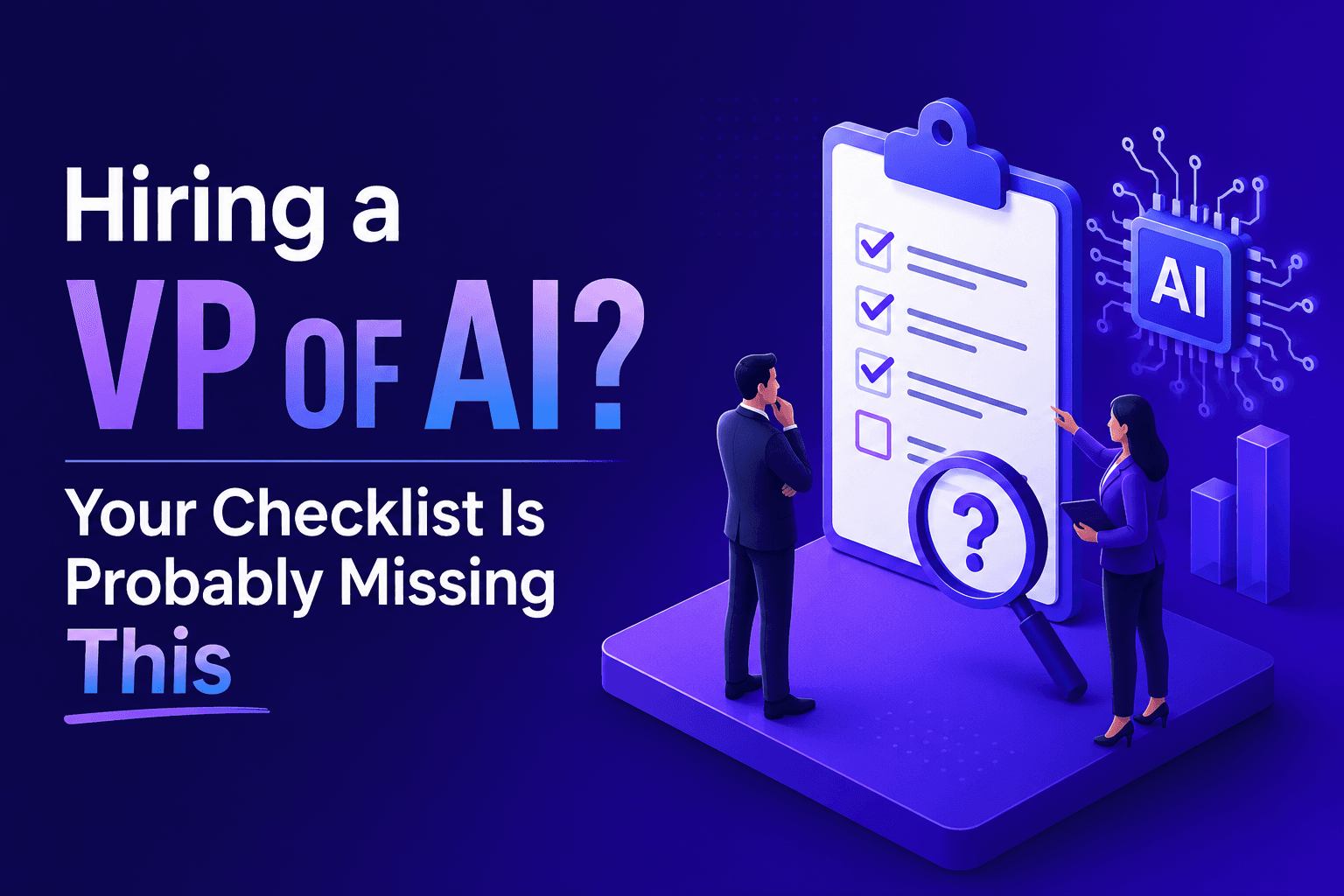
Most VP of AI searches screen heavily for model expertise and AI strategy, but skip a requirement that matters just as much for customer-facing mandates: deployment leadership, meaning direct experience building and owning AI systems inside a paying customer's environment after launch. A candidate can ace every question about model selection and still have never carried that specific kind of responsibility. Whether that gap matters depends entirely on the mandate.
Table of contents
The requirement most searches miss
Why this distinction matters right now
What it costs to get the search wrong
Define the mandate before the candidate profile
Five things to actually screen for
Where these searches typically go wrong
Common mistakes
FAQs
Conclusion
The missing requirement
A strong VP of AI candidate can talk fluently about model selection, architecture tradeoffs, and where AI strategy should sit in the org chart, and still tell a hiring team very little about whether they can actually build a deployment organization. Those are related skills, but they're not the same skill, and the gap between them only becomes visible once a company needs the second one.
For mandates that involve putting AI into production inside customer environments, the overlooked requirement is deployment leadership: real experience building or running the function responsible for that work, tested through what a candidate actually owned once a system went live, not just what they built before launch.
Two adjacent backgrounds get mistaken for this experience constantly. Building AI tools for a company's own internal operations is one, where requirements come from internal stakeholders inside an environment the company already fully controls. Embedding AI into an existing product is the other, where deployment happens inside boundaries the product team already defined. Both are legitimate, valuable experience. Neither is the same as sitting inside a customer's environment, where requirements shift on the customer's schedule instead of the company's, and where a failure shows up directly in front of the person paying for the system.
How to Build a Manager Development Program
Why it matters now
The shift toward this specific requirement isn't speculative. It's already showing up in how enterprises are staffing internal AI functions.
Christian & Timbers' AI-Native Builder Report 2026 found that 70% of large enterprises are already building or actively planning internal forward deployed engineering (FDE) teams, moving deployment capability from a handful of pilot engineers into a standing, permanent function. Model access itself is becoming less of a differentiator, since enterprise buyers can now reach capable models from several providers without much friction. What's genuinely hard to acquire is the talent that can turn that access into systems that survive contact with a real customer's data and workflow.
The same research points to why enterprises are investing in this specifically. Roughly 40% of Palantir's large enterprise clients say they stay for continued access to Palantir's engineers rather than for the software itself, according to Christian & Timbers' research, a strong signal that the deployment relationship itself, not just the underlying model or platform, is what customers are actually paying to retain.
For a VP of AI expected to build that kind of capability internally, experience leading a deployment team becomes directly and immediately relevant to the mandate, not a nice-to-have credential. For a VP of AI hired purely for internal transformation or product integration, it may add comparatively little to the search, which is exactly why the mandate has to be defined before the screening criteria are.
The cost of getting it wrong
Fixing a misdefined search mid-process is expensive, and the numbers make clear why getting the spec right from the start matters.
According to Christian & Timbers' 2026 Corporate AI Compensation Study, drawn from Lightcast's analysis of more than 100 million job postings alongside the firm's own search data, senior GenAI-specialized roles average 54 or more days to fill, among the longest fill times of any technical hiring category right now. VP of AI base salary typically starts around $300,000 at companies in the 2,000 to 5,000 employee range and can reach $1.05 million at companies with more than 100,000 employees, with total compensation, once equity is factored in, reaching past $7 million at the high end.
For a role that already takes close to two months to fill and can carry seven-figure total compensation, discovering deep into the search that deployment leadership was actually part of the mandate means restarting evaluation against evidence the search was never built to surface. That's not a minor correction. It's closer to running the search twice.
Define the mandate first
The real work here happens before the first interview is scheduled, not during it.
If the mandate centers on improving internal workflows or integrating AI into an existing product suite, deep forward deployed experience may add relatively little value to the search, and screening heavily for it risks passing over strong internal or product-focused candidates for the wrong reason. The profile changes meaningfully once the mandate includes building AI systems for individual customers, or taking deployments from an early pilot into production across multiple accounts. For those searches, deployment leadership belongs in the candidate specification from day one, not layered on after a shortlist already exists built against the wrong evidence.
Five things to screen for
Generic descriptors like "customer-focused" or "hands-on" reveal almost nothing about whether a candidate has actually done this work. The following five areas ask for evidence that's harder to fake.
What to screen for | What to actually ask |
|---|---|
Deployment ownership | Name a specific deployment inside a paying customer's environment you owned end to end. What stayed your responsibility after it went live, beyond what you built before it shipped? |
Customer-facing technical work | Describe how a specific requirement changed mid-deployment, and what you did about it in real time, not secondhand through sales or product. |
Measurable production outcomes | What's the specific number the customer would cite to justify the deployment's cost, whether that's adoption, renewal, retention, or a hard cost or time figure? |
Team-building experience | Who did you hire onto a forward deployed or applied AI function, and what specifically made that hire work? How did the team change as deployments scaled from a handful to dozens running at once? |
Handling deployment constraints | Walk through a system failing or underperforming with a customer watching. What was the process your team used to fix it under that pressure, and who noticed the problem first, your team or the customer? |
That last question in particular tends to surface real signal fast. A candidate who's actually lived through a production failure in front of a paying customer describes it very differently than a candidate reasoning through a hypothetical.
Where searches go wrong
Interview time in most VP of AI searches skews heavily toward model selection, product vision, and sometimes architecture decisions. These are reasonable questions, and a strong internal or product leader will answer them well. What that line of questioning rarely tests is whether a deployment actually held once a paying customer's business depended on it, as opposed to whether a demo impressed the room during the interview process itself.
The gap tends to become visible at the worst possible moment: after the company has already decided to build a forward deployed function and discovers the executive responsible for AI has never actually built one.
A second, related blind spot comes from the title itself. The strongest candidate for a customer-deployment mandate may not currently hold a VP of AI title at all. That experience often sits inside forward deployed engineering or applied AI roles that never carried the VP label. Searching for title matches narrows the pool around candidates who look right on an org chart while quietly passing over people who've already built the exact capability the company needs.
Common mistakes
Screening every VP of AI candidate the same way regardless of mandate. A role built around internal transformation and a role built around customer deployment call for genuinely different evidence, and applying one universal rubric to both misses candidates on both sides.
Treating internal or product AI experience as interchangeable with deployment experience. Both are real, valuable skill sets. Neither one substitutes for having absorbed a requirement that shifted on a customer's timeline and owned the fallout when a live system broke in front of them.
Filtering by title before evaluating evidence. Some of the strongest deployment-capable candidates have never held a VP-level title, since this capability has only recently become its own distinct executive mandate rather than a title with an established career ladder.
Adding the deployment requirement after the shortlist already exists. By that point the search has already been built and run against the wrong evidence, and retrofitting the criteria doesn't recover candidates who were screened out earlier for the wrong reasons.
FAQs
What is the difference between internal AI experience and forward deployed engineering experience? Internal AI work happens inside boundaries a company already controls, with requirements coming from internal stakeholders. Forward deployed engineering happens inside a customer's environment, where requirements shift on the customer's schedule and a failure is visible directly to the person paying for the system. The two demand different judgment even though they can look similar on a resume.
Does every VP of AI role need forward deployed engineering experience? No. It matters specifically for mandates centered on deploying AI inside customer environments. Roles focused on internal transformation or product integration have a different, equally legitimate set of criteria to screen against.
How long does it typically take to fill a VP of AI role? According to Christian & Timbers' 2026 Corporate AI Compensation Study, senior GenAI-specialized roles average 54 or more days to fill, one of the longest fill times of any technical hiring category currently.
What does a VP of AI typically earn? Base salary generally starts around $300,000 at mid-sized companies (2,000 to 5,000 employees) and can reach $1.05 million at companies with more than 100,000 employees, with total compensation exceeding $7 million once equity is included at the high end, according to Christian & Timbers' research.
Should a strong candidate be disqualified for never holding the VP of AI title? Not necessarily. Relevant deployment experience often sits inside forward deployed engineering or another customer-facing technical role that never carried the VP of AI label. Evaluating the actual deployment evidence matters more than matching the title on a resume.
Conclusion
A VP of AI candidate who speaks fluently about models and strategy has cleared a real bar, but it's not the same bar a customer-facing deployment mandate actually requires. The fix isn't a longer interview about AI knowledge. It's defining, before the search starts, what the executive will actually be expected to own once a customer's business depends on the system working, then evaluating candidates against evidence of that specific experience rather than title or general AI fluency alone.
Sources
Christian & Timbers, AI-Native Builder Report 2026 (forward deployed engineering team adoption, Palantir client retention data)
Christian & Timbers, 2026 Corporate AI Compensation Study, drawing on Lightcast analysis of more than 100 million job postings (fill-time and compensation figures)



Previous

WeWork's spectacular collapse wasn't simply a founder story. It was a governance story, a psychology story, and a cautionary tale about what happens when growth becomes more important than judgment.
Next

Europe's deeptech boom isn't being powered by capital alone. It's being driven by specialist investors who know how to evaluate science, scale breakthrough technologies, and back long-term innovation.