•
8 Mins Read





Key Summary
Data transformation is an ownership problem: technology matters, but clear accountability across data, analytics, engineering and business functions matters more.
C-suite leaders must give data leaders real authority: transformation works when executives break silos, model data-driven decision-making and connect insights directly to business priorities.
Measure decisions, not dashboards: the real test of transformation is whether data improves measurable outcomes such as efficiency, revenue, customer experience or decision speed.
Data transformation rarely fails because an organization lacks data.
It fails because nobody is quite sure who should turn that data into decisions.
For C-suite leaders, that distinction matters. A successful data transformation requires more than new platforms, AI models or better dashboards. It requires the right people with clearly defined authority, the ability to work across functions and enough executive backing to turn insights into action.
Data Transformation Is a Leadership Problem, Not Just a Technology Problem
Data transformation involves converting raw information into something an organization can actually use. That can mean cleaning and standardizing data, aggregating it into meaningful measures or enriching it with additional context. The objective is ultimately business-facing: better operations, stronger forecasting, more informed marketing, improved risk management and new revenue opportunities.
Technology makes this possible, but technology alone does not create a data-driven organization.
Someone still has to decide which problems matter, establish standards, connect teams and make sure insights influence actual decisions. That is where data leadership becomes critical.
Start By Defining Who Owns What
The first mistake many organizations make is treating "the data team" as one homogeneous function.
Different responsibilities require different forms of expertise.
A Chief Data Officer can own the broader data agenda and its alignment with business strategy. A Chief Analytics Officer can focus on turning data into actionable insight. Data scientists can apply statistical and machine learning techniques to business problems, while data engineers build and maintain the infrastructure required to make those activities possible.
The exact structure will vary by organization. The important question is not whether a company has every possible data title.
It is whether every critical part of the transformation has a clear owner.
That ownership should be tested against three things: alignment with business objectives, technical and data-management expertise, and the ability to collaborate across functions.
If the objective is increasing sales, for example, the organization needs people capable of translating sales data into commercial decisions. If the challenge involves sensitive information, governance and security expertise become equally important.
Data transformation is therefore not a technology project that happens to involve people.
It is an organizational change effort that happens to depend heavily on technology.
The C-Suite Has to Give Data Leaders Real Authority
Assigning a title without giving that person influence is one of the fastest ways to fragment a transformation.
C-suite leaders have several responsibilities here. They need to provide access to the analytical tools and infrastructure teams require, establish clear reporting lines and decision rights, connect data teams with business functions and make successful data initiatives visible across the organization.
That last point is particularly important.
Employees pay attention to what senior leaders actually do, not simply what they say about becoming data-driven.
When executives consistently use evidence to make decisions, they demonstrate that data is part of how the company operates rather than another transformation initiative running alongside the business.
Netflix offers a useful example. Former CEO Reed Hastings emphasized understanding customer behavior through data, including what customers watched and how they interacted with the company's platform. The message was not simply that Netflix had data. It was that understanding customer behavior through data was fundamental to how the company competed.
Data Fluency Cannot Stay Inside the Data Team
A genuinely data-driven organization cannot depend on a small group of specialists to interpret every important question.
Employees across the organization need enough data fluency to understand the information they encounter, question assumptions and use analytical tools appropriately. That means training people to work with data rather than treating data literacy as the exclusive responsibility of technical teams.
The practical payoff can be significant.
Cambridge University Press & Assessment's Tom Buckham described using newly developed data-analysis skills to determine how existing systems were being used and how much information might need to be migrated. That analysis helped avoid potentially unnecessary spending and allowed resources to remain focused on customer priorities.
That is what data transformation looks like when it reaches the operating level.
Not another dashboard.
A better decision.
The Transformation Never Really Ends
One of the most important shifts for C-suite leaders is to stop thinking of data transformation as a project with a beginning and an end.
Data changes. Customer behavior changes. Technology changes. Business priorities change.
The organization therefore has to keep improving how it collects, interprets and applies information. The source also points to Procter & Gamble's use of a "decision cockpit," giving managers access to as much as 200 terabytes of visualized data to support faster decisions.
The underlying principle is more important than the technology itself.
Data should become part of the operating system of the business.
The Biggest Obstacles Are Organizational
The technical problems are often easier to identify than the organizational ones.
Employees may resist new technology, departments may continue operating with isolated data sets and teams may struggle with the cultural changes required to adopt data-driven decision-making.
These problems require leadership, not simply implementation.
Executives need to explain why the transformation matters, involve employees early, make responsibilities clear and create incentives for teams to share information rather than protect their own data silos.
One example cited in the source comes from TrendBible, where unifying siloed data analytics was estimated to save 647 hours annually. The point is simple: breaking down data silos can produce very tangible operational benefits.
Measure The Transformation In Business Terms
A data transformation should eventually show up in the numbers that matter to the business.
That means tracking more than the number of dashboards created or models deployed.
Organizations can measure data accessibility, operational efficiency and revenue impact, while selecting additional KPIs based on the specific outcomes they are trying to improve.
The healthcare example in the source illustrates the principle well. Cambridge Spark apprentice Joel Hollingsworth used patient referral time as a key metric and identified changes that reduced referral delays by up to 75%.
The lesson is straightforward.
If data transformation cannot be connected to a measurable business outcome, it becomes very difficult to distinguish transformation from activity.
The Real Role of C-Suite Leadership
The C-suite does not need to become the organization's best data scientist.
It needs to make sure the organization knows who owns the data strategy, who turns information into insight, who connects those insights to business decisions and who has the authority to make change happen.
That means identifying the right strategic roles, giving them resources and decision-making authority, breaking down functional silos and making data-driven behavior visible from the top.
Because data transformation ultimately isn't about having more information.
It's about building an organization capable of doing more with the information it already has.
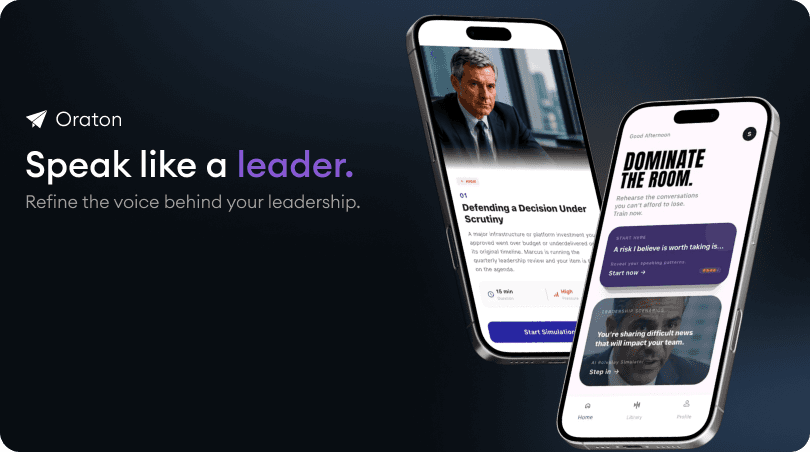
At Oraton, leaders rehearse the high-stakes conversations that turn strategy into action, from challenging functional silos and aligning executives to giving strategic roles the authority they need to drive transformation.
Because transformation rarely gets stuck in the dashboard.
It gets stuck in the conversation that nobody prepared to have.
Rehearse that conversation with Oraton →



Previous

Discover how to become more articulate through practical exercises that strengthen pronunciation, vocal energy, and speech clarity, helping leaders communicate with greater precision and presence.
Next

Discover how Hedy Lamarr and composer George Antheil developed a wartime communications patent that helped shape the history of wireless technology, and what their story teaches leaders about innovation, collaboration and unconventional ideas.